
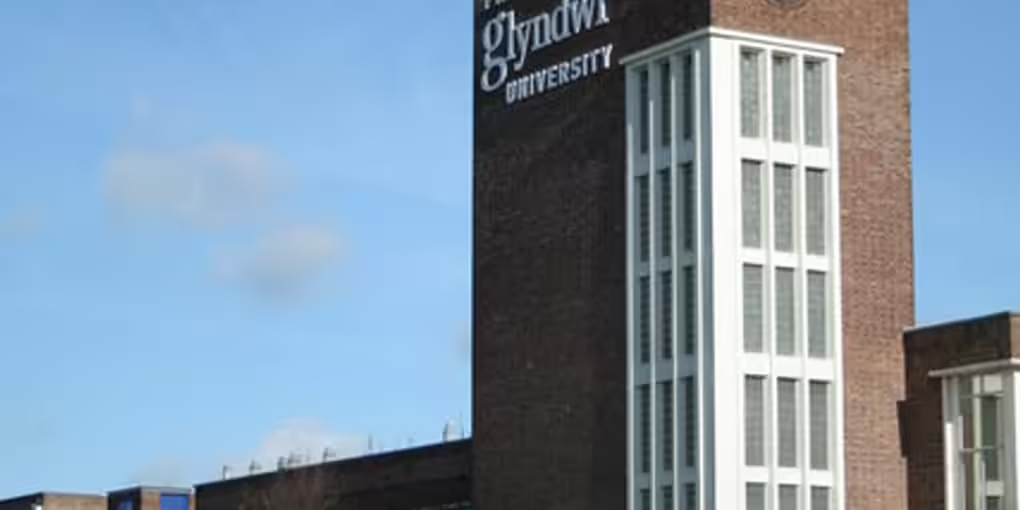
Wrexham University – University Guide for GCC and Southeast Asian Students
Overview
Wrexham University (formerly Glyndŵr University) is a supportive, community-focused Welsh university that can suit international students who want applied degrees, competitive international tuition often among the lower UK bands, and access to Chester and Manchester for placements and graduate opportunities.
Its main campus sits in Wrexham, North Wales — a market town near the English border. For families from the GCC and Southeast Asia, Wrexham is usually shortlisted for:
- Competitive international fees — often in the mid-£11k–£14k band for many undergraduate programmes (always confirm on the official course page)
- Strengths in engineering, computing, business, nursing, art/design and sport
- A smaller, supportive campus where staff know students by name
- Lower day-to-day living costs than London or many southern English cities
- Regional access to Chester, Liverpool and Manchester for internships and graduate jobs
If your family is comparing UK options on value, affordability and close-knit community, Wrexham University deserves a place on a realistic shortlist.
Rankings snapshot (latest major league tables)
Wrexham is not typically selected as a prestige-first destination in the way families might approach Oxbridge, Cardiff, Manchester or the stronger Russell Group names. Its positioning is more about affordability, student support and applied professional pathways.
In recent major UK league tables it often sits in the UK top 100+ band overall, with stronger recognition in areas such as:
- Engineering and technology — applied, industry-facing study
- Computing and digital technologies — practical tech routes
- Business and management — career-oriented programmes
- Nursing and health-related fields — professional qualification pathways
- Art, design and creative media — studio-based teaching
- Sport and exercise science — vocationally oriented routes
Globally, Wrexham tends to appear in broader mid-to-lower ranked international bands rather than the very top global tables. For many GCC and SEA families, the more useful question is whether the fee band, supportive campus culture and subject fit match the student’s goals.
Practical takeaway for parents: use rankings as context, not the only filter. At Wrexham, affordability, community support and course fit often matter more than league-table rank alone.
Popular degrees for GCC and Southeast Asian students
Wrexham offers a focused portfolio across engineering, computing, business, health, creative arts and sport. For students from the Gulf and Southeast Asia, interest tends to cluster around professionally oriented degrees at accessible fee levels.
Particularly strong and popular for
- Engineering and technology — applied, industry-facing study with workshop and lab facilities
- Computing, cybersecurity and IT-related programmes — popular with students aiming for tech careers with Manchester regional access
- Business and management — including international business with clear career framing
- Nursing and allied health — chosen by students focused on professional qualification routes
- Art, design and creative media — studio-based routes for students building portfolios
- Sport, exercise science and related pathways — practical routes for coaching, performance or health science interests
Less commonly chosen (from this region)
- Pure prestige-signalling routes where families want the strongest brand recognition first
- Ultra-competitive medicine pathways (health offerings exist but Wrexham is not primarily a medical-school destination)
- Students whose non-negotiable priority is a large metropolitan city-university lifestyle
Why these courses appeal to GCC and SEA families
Many families from these regions value:
- Among the lower UK international tuition bands — meaningful savings over a full degree
- A small, supportive campus for a first UK experience abroad
- Lower living costs in North Wales than London or southern England
- Regional access to Manchester, Chester and Liverpool for placements and graduate jobs
- Applied teaching focused on employability rather than research prestige
Campus type and location
- Town: Wrexham, Wrexham County Borough, North Wales
- Type: Compact campus university in a market town near the Welsh–English border
- Setting: Smaller supportive community with walkable campus and town access
Wrexham sits close to the English border, with Chester roughly 15–20 minutes away by road or rail and Manchester roughly 45–60 minutes by train. The campus combines teaching buildings, libraries, creative studios, sports facilities and accommodation within a manageable footprint — ideal for international students who prefer simplicity over metropolitan complexity.
Why location matters for international families
Wrexham gives students:
- Lower day-to-day living costs than London, Manchester city centre or many southern cities
- Fast access to Chester — a historic English city with retail, culture and employment links
- Train links to Manchester for internships, interviews and graduate opportunities
- Liverpool also reachable for regional placements and leisure
- A quiet, community-focused study base — good for students who prefer calm over big-city intensity
For many GCC and Southeast Asian students, Wrexham offers a “value + support + regional city access” model that prioritises affordability and personal attention over prestige branding.
Student demographic and culture
Wrexham teaches roughly 6,000–8,000 students — small by UK standards, which shapes a personal, community-oriented culture.
The university has a growing international community alongside a strong Welsh and UK cohort. The culture tends to feel:
- Friendly, approachable and supportive
- Less prestige-driven than elite Russell Group institutions
- Community-focused — staff and students often know each other
- Practical and career-oriented in engineering, computing and business
- Creative and collaborative in art, design and media programmes
- Welsh-identity aware without excluding international students
Male to female balance
Balanced overall, with subject-level variation:
- Engineering and computing cohorts may lean more male
- Nursing and some health programmes often lean more female
- Art, design and business programmes are often closer to even
Who tends to thrive at Wrexham
Students who usually do well here are those who:
- Want engineering, computing, business, nursing, art/design or sport degrees with applied teaching
- Value competitive international fees and lower North Wales living costs
- Prefer a small, supportive campus over a large anonymous university
- Are comfortable with a market-town setting and regional travel to Manchester or Chester
- Benefit from personal contact with lecturers and a close community
Students who need constant big-city energy, elite prestige branding or the widest possible metropolitan employer-network density may prefer London, Manchester or a Russell Group first choice.
Accommodation options
On-campus and university-managed accommodation is available for first-year students, with options typically including:
- Standard single rooms in halls
- En-suite rooms in selected residences
- Self-catered contracts on most hall agreements
Many halls sit on or near the main campus, keeping daily commutes short. Bills are usually included in hall contracts, which simplifies budgeting for international families.
Cost and budgeting notes for international families
Living in Wrexham is generally more affordable than London, Manchester city centre or many southern English cities. Families should still plan for:
- Accommodation for the academic year
- Food, personal expenses and occasional Manchester/Chester travel
- Warm clothing and outdoor gear (Welsh weather is mild but changeable)
- Flights and arrival costs (Manchester Airport is the main international gateway)
For tuition figures, deposits and scholarships, see Fee structure below.
Fee structure
For GCC and Southeast Asian families, Wrexham is often considered one of the more affordable UK options for international tuition — typically in the £11,000–£14,000 band for many undergraduate programmes, though exact figures vary by course and intake. Always confirm the latest figures on the official course page and offer letter.
International tuition fees (indicative, 2026/27)
| Level | Typical annual tuition |
|---|---|
| Undergraduate — classroom-based programmes | Commonly around £11,000–£13,000 per year |
| Undergraduate — lab-based or specialist programmes | Commonly around £12,500–£14,000 per year |
| Postgraduate taught | Often around £12,000–£15,000 per year (varies by programme) |
Useful points for parents:
- Wrexham’s fees are often among the lower UK international bands — a significant budgeting advantage over London or top-tier Russell Group options.
- Fees differ by subject band — lab-based, engineering and professional courses may sit at the higher end.
- Always check the exact course page for the intake year; published bands are planning guides only.
- Postgraduate fees vary by school and professional accreditation requirements.
Deposit, CAS and payment timing
If a student needs a CAS (Confirmation of Acceptance for Studies) for a UK Student Visa, Wrexham typically requires a deposit after an offer is accepted. The exact amount and deadline appear in the offer letter — plan for this early.
Families should plan for:
- Offer received (conditional or unconditional)
- Deposit payment by the deadline stated in the offer
- CAS issued for the visa application
- Remaining tuition paid according to university payment options
Scholarships and fee reductions (high-level)
Wrexham offers international scholarship routes that can reduce net cost further for strong applicants. Typical examples families should ask about include:
- Merit-based international scholarships (amounts vary by academic profile and intake)
- Country- or region-specific awards where advertised
- Alumni progression discounts for students continuing from Wrexham undergraduate to postgraduate study
Practical tip: scholarship eligibility and deadlines change by intake. Treat published ranges as planning guides, then confirm what appears in the student’s offer and scholarship communications.
Living costs beyond tuition
North Wales living costs are typically lower than London or major English cities, but UK Student Visa financial evidence requirements still apply. Families should budget separately for:
- On-campus or private accommodation in Wrexham
- Food and daily expenses
- Local and regional transport (Manchester, Chester travel for placements)
- Books, equipment or portfolio materials (especially for engineering, art and lab courses)
- Flights and arrival costs
Admission procedure
Wrexham’s admissions process is generally accessible compared with ultra-selective Russell Group universities, but families should still plan early — especially around English language evidence, portfolio requirements for creative courses, deposit timing and visas.
Undergraduate applications
Most international undergraduate applicants apply through:
- UCAS (standard route for Year 1 entry), and/or
- University/international application channels or approved in-country representatives
Typical requirements include:
- Completion of around 12 years of schooling with a qualification equivalent to UK A Levels (or accepted national equivalents from GCC/SEA systems)
- Meeting the course-specific academic tariff (competitive programmes such as nursing may ask for stronger grades)
- A personal statement and supporting documents (transcripts, passport details, references as required)
- English language evidence where needed
- Portfolio or creative submission for art, design and selected media courses
English language for many undergraduate courses is commonly around IELTS 6.0 overall (with minimum band scores), though nursing and health programmes may ask for higher scores. Always check the exact course page.
Postgraduate applications
Postgraduate taught applications are usually made directly to the university (via the course page) or through approved representatives.
Typical requirements include:
- A relevant bachelor’s degree at a level broadly equivalent to a UK second-class honours degree
- Academic transcripts and degree certificate
- Personal statement / CV where requested
- References (often academic)
- English language evidence — commonly around IELTS 6.0–6.5, with higher requirements for health and professional programmes
- Portfolio or interview for art, design and selected creative courses
Step-by-step pathway for international families
- Shortlist the course — confirm entry requirements, fees, intake month and any portfolio requirement.
- Prepare academics and English — strengthen IGCSE/A Level (or equivalent) profiles early; build portfolio work for creative routes.
- Submit the application — via UCAS for undergraduate routes, or direct/representative routes for postgraduate.
- Receive an offer — conditional (e.g. pending grades/English) or unconditional.
- Accept the offer and pay the deposit — required for CAS in most visa cases.
- Receive CAS and apply for the Student Visa — usually no earlier than six months before the course start date.
- Arrange accommodation and arrival — on-campus housing is often the simplest first-year option for international students.
Intakes and timing
- September is the main intake for most undergraduate and postgraduate programmes.
- Selected postgraduate courses may offer January entry — check individual programme pages.
- Undergraduate UCAS timelines matter: equal-consideration deadlines are usually in January for September entry, with later applications possible subject to availability.
Documents checklist (typical)
- Academic transcripts and certificates
- Passport copy
- Personal statement
- Reference(s)
- English language test results (if required)
- Portfolio for art, design and creative courses where required
For GCC and SEA applicants: national curriculum results are assessed against Wrexham equivalency guidance. If grades fall short of direct entry, foundation or pathway routes may be available — useful as a structured alternative.
Academic intensity and social life
Academic expectations are serious — especially on engineering, computing, nursing and professional courses — but the overall atmosphere is less hyper-competitive than elite Russell Group universities.
What students can expect:
- Smaller class sizes and more direct contact with academic staff
- Teaching that emphasises applied skills and employability
- Workshop, lab and studio elements in engineering, computing and creative programmes
- A campus where study and community life blend naturally
This balance works well for students who want focused study in a supportive environment rather than prestige competition.
Social life in practice
Wrexham’s social scene is quieter and community-based than big-city universities. Students build friendships through societies, sports clubs, hall life and the town’s cafes and venues. Manchester and Chester provide bigger-city options for weekends and placements. Parents should discuss expectations openly — this is not a London-style nightlife destination.
Sports, societies and wider profile
Wrexham offers clubs and societies spanning cultural groups, academic societies, faith communities, creative clubs and sports teams — with particular activity in sport and exercise related programmes.
The wider profile is that of a small supportive Welsh university:
- Strong on engineering, computing, business, nursing and creative arts
- Community-focused with personal staff-student relationships
- Good campus facilities for sport and recreation relative to university size
- Less associated with elite varsity prestige sport than older UK universities
- Growing international student community within a bilingual Welsh context
For GCC and SEA students, cultural societies and the international office’s welcome programme can be especially useful in the first term.
Careers and employer reputation
Wrexham’s employer reputation is strongest in its applied subject areas — engineering, computing, business, nursing, art/design and sport — rather than as a generic prestige brand.
Where Wrexham can be especially sensible
- Students targeting engineering, computing, business, nursing or creative careers with applied goals
- Families who want among the lower UK international tuition bands
- Applicants who value a small, supportive campus for a first UK experience
- Students planning to use Manchester, Chester or Liverpool regional job markets for placements and graduate roles
Where families should be realistic
Wrexham will not carry the same brand weight as Manchester, Cardiff or top Russell Group names in highly competitive prestige markets. That does not mean weak outcomes — it does mean families should evaluate:
- The specific course reputation and accreditation
- Placement plans (regional travel to Manchester may be needed for some sectors)
- Post-study work goals and location preferences
Used well, Wrexham University can be an excellent “affordability + support + applied learning” choice.
Who should shortlist Wrexham University?
Consider shortlisting Wrexham if your child:
- Wants engineering, computing, business, nursing, art/design or sport degrees with applied teaching
- Values competitive international fees often among the lower UK bands
- Prefers a small, supportive campus over a large metropolitan university
- Is comfortable with a North Wales market-town setting and regional access to Manchester/Chester
- Benefits from lower living costs than London or southern England
Consider other options first if your child:
- Needs the strongest possible prestige signal for ultra-competitive pathways
- Requires constant metropolitan internship access without regional travel
- Prefers large-scale nightlife, diversity of city amenities or Russell Group branding as a non-negotiable
How Tutopiya helps
Tutopiya works with students aiming for Wrexham University and other UK universities by:
- Strengthening grades in IGCSE and International A-Level subjects that matter for entry — especially mathematics, sciences, English and business pathways
- Building competitive academic profiles early enough for realistic university shortlists
- Preparing for admissions tests, English language goals, portfolio reviews and interviews where relevant
- Helping families understand fees, deposits, scholarships and application timelines
- Providing university counselling that weighs ranking, cost, course fit, campus community and progression honestly
- Issuing reference letters for tutoring and homeschooling students where Tutopiya has supported the student’s academic programme — useful for UCAS applications and direct-entry paperwork when school references are limited or unavailable
- Connecting families with unpaid internship and work-experience opportunities (where available) to strengthen personal statements, portfolios and graduate CVs before and during university applications
If you’d like tailored advice for your child’s situation, you can talk to Tutopiya’s team about a joined-up plan covering both exam preparation and university admissions.
Ready to Excel in Your Studies?
Get personalised help from Tutopiya's expert tutors. Whether it's IGCSE, IB, A-Levels, or any other curriculum — we match you with the perfect tutor and your first session is free.
Book Your Free TrialWritten by
Tutopiya Team
Related Articles
Adelaide University – University Guide for GCC and Southeast Asian Students
Detailed guidance for international students from the Gulf and Southeast Asia considering Adelaide University, including fees, admissions, popular degrees, multi-campus Adelaide life, accommodation and graduate outcomes.

Australian Catholic University – University Guide for GCC and Southeast Asian Students
Detailed guidance for international students from the Gulf and Southeast Asia considering Australian Catholic University (ACU), including fees, admissions, popular degrees, multi-campus life across Sydney, Melbourne, Brisbane and Canberra, accommodation and graduate outcomes.
Australian National University – University Guide for GCC and Southeast Asian Students
Detailed guidance for international students from the Gulf and Southeast Asia considering the Australian National University (ANU), including fees, admissions, popular degrees, Canberra campus life, accommodation and graduate outcomes.