
UNSW Sydney – University Guide for GCC and Southeast Asian Students
Overview
UNSW Sydney is one of Australia’s most internationally connected Group of Eight universities, and for many GCC and Southeast Asian families it is the default shortlist name when the priority is engineering, technology, business or finance in Sydney. The main Kensington campus sits in Sydney’s eastern suburbs, close enough to the CBD and airport corridor to make internships and graduate recruitment feel practical rather than theoretical.
Around 66,000 students study at UNSW, giving it genuine scale without losing a strong professional-school identity. Families researching UNSW most often focus on:
- Engineering — among Australia’s best-known and most employer-recognised engineering faculties
- Computer Science, Data Science and AI — heavy demand from SEA applicants targeting technology careers
- Business and Finance — strong links into Sydney’s consulting, banking and corporate markets
- Architecture and Built Environment — a distinctive creative-professional pathway
- Law — a competitive Go8 law offering with Sydney professional networks
- International tuition typically in the A$42,000–A$60,000 band for undergraduate study (always confirm on the official course page)
Families whose child is academically strong, career-oriented and ready for Sydney living costs plus a trimester academic calendar tend to find UNSW one of the sharpest “employability-first” Australian options. Compared with more traditional sandstone campuses, UNSW’s identity is unapologetically professional and industry-facing.
Rankings snapshot (latest major league tables)
UNSW consistently ranks among Australia’s and the world’s leading universities, with particular strength in technology and professional disciplines:
- QS World University Rankings — UNSW typically sits around #20 globally, placing it among Australia’s top handful of universities
- Engineering and Technology — regularly among Australia’s strongest and highly visible to international employers
- Computer Science and Information Systems — a major draw for Southeast Asian applicants targeting software, data and AI careers
- Business and Management / Accounting and Finance — strong graduate outcomes into Sydney’s corporate and financial-services markets
- Architecture and Built Environment — a subject area where UNSW’s reputation often exceeds that of many peer Go8 campuses
Practical takeaway for parents: UNSW’s overall ranking is already excellent, but its employer brand in engineering, technology and business is often the deciding factor for GCC and SEA families comparing it with Sydney, Melbourne or ANU.
Popular degrees for GCC and Southeast Asian students
Particularly strong and popular for
- Engineering (civil, mechanical, electrical, chemical, software and related streams) — the faculty most closely associated with the UNSW brand internationally
- Computer Science, Data Science and AI — high demand, competitive entry and strong postgraduate progression
- Commerce, Business and Finance — designed with Sydney’s graduate-recruitment calendar in mind
- Architecture and Design — studio-intensive programmes with professional accreditation pathways
- Law — selective, with clear routes into Sydney legal practice and further study
Less commonly chosen (from this region)
- Pure arts or humanities degrees without a professional overlay — possible, but not why most GCC/SEA families shortlist UNSW
- Agriculture or regional resource programmes better matched to universities with rural/industry campuses
- Quiet, low-intensity study environments — UNSW’s culture is competitive and career-driven
Why these courses appeal to GCC and SEA families
- Employer recognition in engineering, technology and finance is among the strongest of any Australian university
- Sydney’s internship and graduate-job density is difficult to replicate in smaller capitals
- The trimester calendar can allow faster progression or denser study years for motivated students
- A highly international student community, especially across STEM and business faculties
- Clear pathways from undergraduate study into competitive postgraduate professional programmes
Campus type and location
- City: Sydney, New South Wales
- Type: Large public research university (Group of Eight)
- Setting: Main campus at Kensington, with additional facilities and partnerships across greater Sydney
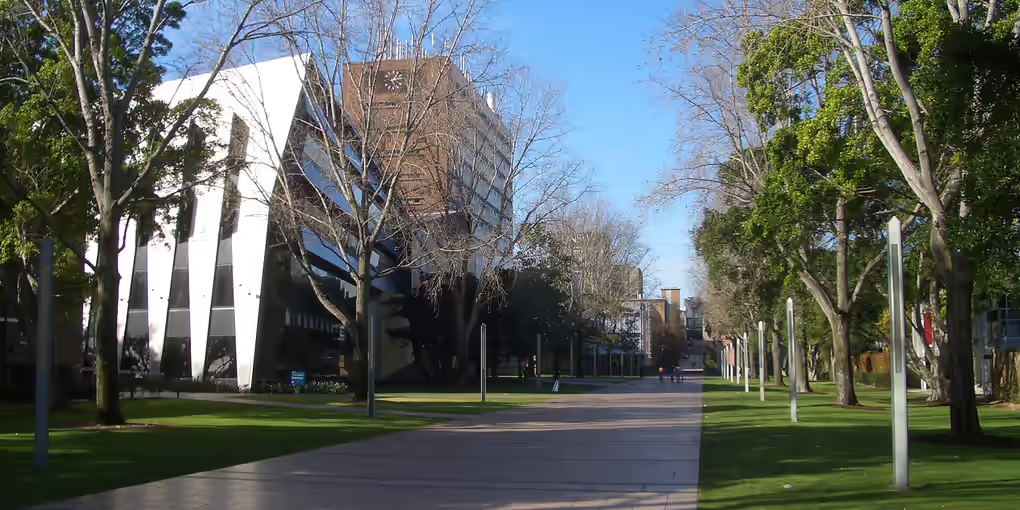
Kensington is a self-contained suburban campus rather than a CBD tower university: teaching buildings, libraries, food outlets and much student housing sit within a walkable precinct, with buses linking to the CBD, Bondi Junction and the airport corridor.
Why location matters for international families
UNSW’s Sydney location is both its greatest asset and its biggest budgeting challenge:
- Proximity to technology, consulting, engineering and finance employers makes internships and networking unusually practical
- Eastern-suburbs and inner-Sydney rents are among Australia’s highest — families must budget early and realistically
- The campus itself is lively and well-equipped, but students still need to travel into the CBD for many corporate events and interviews
- Beach suburbs and Sydney’s social scene are close enough to feel part of daily life, not a weekend excursion
For GCC and Southeast Asian students, Sydney’s climate is generally comfortable year-round compared with southern capitals, but humidity and the cost of living — not weather — are the adjustments families underestimate most often.
Student demographic and culture
UNSW enrols around 66,000 students, with a large and highly international cohort, particularly in Engineering, Business and Computer Science. The culture tends to feel:
- Competitive, career-focused and professionally ambitious
- Genuinely global, with strong representation from East Asia, Southeast Asia and the Middle East
- Fast-paced academically, especially under the trimester structure
- Well supported through an established international student office and faculty societies
Male to female balance
Varies clearly by faculty:
- Engineering and Computer Science cohorts lean more male, though female enrolment has been rising
- Business, Law and Architecture sit closer to balanced
- Overall campus life is diverse enough that most students find peer communities quickly
Who tends to thrive at UNSW Sydney
Students who usually do well here are those who:
- Are academically capable and self-driven, comfortable with a competitive peer group
- Are targeting engineering, CS/AI, business, finance, architecture or law
- Want Sydney internship and graduate-recruitment access as a core part of the degree experience
- Can adapt to a trimester calendar with shorter breaks and denser assessment cycles
- Have family support for Sydney-level living costs across the full degree
Students seeking a quieter, lower-cost campus lifestyle — or who struggle with high-pressure academic environments — may find Brisbane, Adelaide or Perth Go8 options a better fit.
Accommodation options
UNSW offers on-campus colleges and university-affiliated housing at and around Kensington, with a large private rental market in surrounding suburbs. Typical arrangements include:
- Residential colleges with pastoral support and community programmes
- Self-catered university apartments and partner student residences
- Private share-houses and studios in Kensington, Randwick, Kingsford and nearby suburbs
On-campus and near-campus places are competitive before Semester 1. Many international students secure housing several months ahead of arrival.
Students who leave housing until after visa grant often end up in temporary stays farther from Kensington, adding commute fatigue in an already dense trimester timetable.
Cost and budgeting notes for international families
- Sydney housing is expensive — often the largest non-tuition cost by a wide margin
- Budget for transport (Opal card), food and social costs at Sydney prices, not regional-Australia estimates
- Trimester study can mean less long-break earning time unless students plan carefully around the calendar
- A contingency for bond, furniture and arrival weeks is essential
For tuition figures, deposits and scholarships, see Fee structure below.
Fee structure
For GCC and Southeast Asian families, UNSW typically sits in the upper international fee band consistent with its Group of Eight status — commonly A$42,000–A$60,000 per year for undergraduate study, varying by faculty. These figures are indicative only; always confirm the latest figures on the official course page and offer letter.
International tuition fees (indicative, 2026/27, in AUD)
| Level | Typical annual tuition |
|---|---|
| Undergraduate — Business, some classroom-based programmes | Commonly around A$42,000–A$50,000 per year |
| Undergraduate — Architecture, Law | Commonly around A$46,000–A$55,000 per year |
| Undergraduate — Engineering, Computer Science, laboratory Science | Commonly around A$48,000–A$60,000 per year |
| Postgraduate taught | Often around A$44,000–A$65,000 per year (varies widely by programme) |
Useful points for parents:
- Engineering and Computer Science generally sit toward the top of the undergraduate range.
- Competitive postgraduate programmes in business, data and professional fields can exceed undergraduate fees — check the specific programme page.
- Fees typically increase modestly each year of study; the offer letter states the exact schedule.
Deposit, CoE and payment timing
Students needing a Confirmation of Enrolment (CoE) for a Student visa (subclass 500) should expect UNSW to request an initial tuition deposit after accepting an offer. The exact amount and deadline appear in the offer letter.
Families should plan for:
- Offer received (conditional or unconditional)
- Deposit or initial tuition instalment paid by the stated deadline
- CoE issued once payment and any conditions are confirmed
- Student visa (subclass 500) application lodged using the CoE
- Remaining tuition settled by teaching period through the university’s payment portal
Scholarships and fee reductions (high-level)
UNSW offers a range of international scholarship routes, including:
- Merit-based international scholarships assessed on academic profile at application or offer stage
- Faculty awards within Engineering, Business and Science
- Research scholarships for postgraduate and doctoral applicants
Practical tip: scholarship competition at UNSW is genuine — apply early, treat published amounts as planning guides, and confirm eligibility through official scholarship communications.
Living costs beyond tuition
Australia’s Department of Home Affairs sets a minimum living-cost financial requirement for the subclass 500 visa. For UNSW specifically, families should treat Sydney estimates as a premium band and budget separately for:
- Accommodation for the academic year (often the largest cost after tuition)
- Food, transport and personal expenses at Sydney prices
- Overseas Student Health Cover (OSHC), compulsory for the visa
- Professional clothing and travel for CBD interviews and networking
- Flights and arrival costs
Admission procedure
Undergraduate applications
Most international undergraduate applicants apply directly to UNSW or through an approved education agent — not through UCAS.
Typical requirements include:
- Completion of secondary schooling to a standard broadly equivalent to Australian Year 12, assessed against UNSW’s country-by-country entry requirements (national GCC/SEA curricula are individually assessed)
- Meeting the course-specific entry standard — Engineering, Computer Science, Law and some Business majors are typically highly competitive
- Academic transcripts, certificates and passport details
- English language evidence where required
- Prerequisites in mathematics or science for many STEM programmes
English language for most undergraduate courses is commonly around IELTS 6.5 overall (no band below 6.0), with some programmes requiring higher scores. Always check the exact course page for the intended intake.
Postgraduate applications
Postgraduate taught applications are made directly to UNSW, via the course page or an approved education agent.
Typical requirements include:
- A relevant bachelor’s degree with a competitive grade average
- Academic transcripts and degree certificate
- A CV and, for many programmes, a personal statement
- English language evidence — commonly around IELTS 6.5, higher for some professional programmes
- Academic references for research-intensive and doctoral applications
Step-by-step pathway for international families
- Shortlist the course — check entry requirements, fees, prerequisites and whether the programme runs on the trimester calendar.
- Strengthen academics and English early — especially mathematics for Engineering and Computer Science.
- Apply directly or through an approved agent with certified transcripts and supporting documents.
- Receive an offer — conditional or unconditional.
- Accept the offer and pay the required deposit — needed before a CoE can be issued.
- Receive the CoE and apply for the subclass 500 student visa through the Department of Home Affairs.
- Secure Sydney accommodation early — Kensington and nearby suburbs fill quickly before the main intake.
Intakes and timing
- UNSW’s trimester calendar differs from the classic two-semester Australian pattern — families should map teaching periods, assessment clusters and break weeks carefully.
- The main undergraduate intake remains concentrated around the start of the academic year, with additional entry points for many programmes.
- Competitive Engineering, CS and Business places can fill ahead of informal “late” windows — early application is strongly advisable.
Documents checklist (typical)
- Academic transcripts and certificates
- Passport copy
- English language test results (if required)
- Evidence of mathematics/science prerequisites where relevant
- CV and personal statement (especially postgraduate applicants)
- Academic references (for research-intensive and doctoral applicants)
- Proof of funds where requested ahead of the formal visa application stage
For GCC and SEA applicants: UNSW publishes detailed country-specific grade equivalencies. Where grades fall short of direct entry, approved foundation or diploma pathway programmes may provide an alternative route into first year.
Academic intensity and social life
Academic demands at UNSW are high, and the trimester structure intensifies the feel of continuous assessment. Engineering combines heavy mathematics with design and project work; Computer Science and AI routes emphasise coding projects and algorithmic foundations; Business and Finance lean on case analysis, group work and quantitative methods; Architecture centres on studio culture and portfolio development; Law follows a rigorous reading and examination pattern.
What students can generally expect:
- Dense assessment cycles with shorter breaks than traditional semester universities
- Large lecture cohorts in popular STEM and business subjects, supported by tutorials and labs
- A career-oriented peer culture — internship talk starts early
- Active faculty societies that double as professional networking spaces
Social life in practice
UNSW social life mixes campus societies with Sydney’s broader city scene. Many friendships form through Engineering, Business or cultural societies, then spill into eastern-suburbs cafés, beaches and CBD events. Students who wait passively for a “small-campus” community to form around them can feel anonymous; those who join societies early usually settle faster.
Compared with more heritage-focused Sydney campuses, UNSW’s social calendar often feels organised around professional societies and project teams as much as traditional college ritual.
Sports, societies and wider profile
UNSW’s clubs scene is large and professionally flavoured:
- Engineering, robotics, consulting, finance and entrepreneurship societies are especially active and career-relevant
- Cultural and faith societies supporting Gulf, Southeast Asian and wider international communities
- Competitive and social sport across campus and college teams
- Architecture, design and law societies with strong peer networks
For GCC and SEA students, joining a faculty or professional society in the first teaching period is often the single best way to unlock both friendships and internship information. Many students also use society channels to decode trimester pacing — which electives cluster heavily, and when recruitment cycles align with teaching periods.
Careers and employer reputation
UNSW’s employer reputation is one of the strongest in Australia for engineering, technology and business — and that reputation is a core reason families shortlist it.
Where UNSW can be especially sensible
- Students targeting engineering, software, data, AI, consulting or finance careers
- Applicants who want Sydney internship density as part of the degree experience
- Families seeking a top-20 global brand with clear professional-school identity
- Students comfortable with a competitive, fast-paced academic culture
Where families should be realistic
UNSW is not a low-cost or low-pressure choice. Families should evaluate:
- Whether the household budget can sustain Sydney rents for the full degree
- Whether the student will cope with a trimester workload and competitive peer group
- How placement and internship support works for the specific course — strong overall, but still student-driven
Used well, UNSW works best as an employability-led Sydney Go8 choice — outstanding for ambitious STEM and business students who want the city’s opportunity set and can fund it properly. If the family’s priority is “strong job outcomes in engineering, tech or finance,” UNSW often outranks more generic prestige comparisons.
Who should shortlist UNSW Sydney?
Consider shortlisting UNSW if your child:
- Is academically strong and targeting engineering, computer science/AI, business, finance, architecture or law
- Wants a Group of Eight university with one of Australia’s strongest employer brands
- Is ready for Sydney living costs and a competitive peer environment
- Can adapt to a trimester academic calendar
- Values internship and graduate-recruitment access as much as campus lifestyle
Consider other options first if your child:
- Needs a quieter, lower-cost Australian capital for a first study-abroad experience
- Prefers a traditional two-semester pace with longer mid-year breaks
- Is seeking a small, pastoral college-town atmosphere rather than a large professional university
How Tutopiya helps
Tutopiya works with students aiming for UNSW Sydney and other Australian universities by:
- Strengthening grades in subjects relevant to entry — particularly mathematics, physics, chemistry, English and economics for Engineering, CS and Business pathways
- Building competitive academic profiles early enough for realistic shortlists among Go8 and other Sydney universities
- Preparing for English language goals, personal statements and interviews where relevant
- Helping families understand fees, deposits, scholarships, CoE timing and subclass 500 visa requirements
- Providing university counselling that weighs subject fit, Sydney living costs and career outcomes honestly rather than by ranking alone
- Issuing reference letters for tutoring and homeschooling students where Tutopiya has supported the student’s academic programme — useful for direct-entry applications when school references are limited or unavailable
- Connecting families with unpaid internship and work-experience opportunities (where available) to strengthen applications and personal statements before and during the admissions process
If you’d like tailored advice for your child’s situation, you can talk to Tutopiya’s team about a joined-up plan covering both exam preparation and university admissions.
🎓 Free tool
Build your personalised shortlist for University of New South Wales →
See entry requirements matched to your own grades, tuition, deadlines and reach/target/safety tiering — free, no signup needed to browse.
Ready to Excel in Your Studies?
Get personalised help from Tutopiya's expert tutors. Whether it's IGCSE, IB, A-Levels, or any other curriculum — we match you with the perfect tutor and your first session is free.
Book Your Free TrialWritten by
Tutopiya Team
Related Articles

Heriot-Watt University Dubai – University Guide for GCC and Southeast Asian Students
Detailed guidance for international students from the Gulf and Southeast Asia considering Heriot-Watt University Dubai, including fees, admissions, campus life, accommodation and graduate outcomes.

University of Birmingham Dubai – University Guide for GCC and Southeast Asian Students
Detailed guidance for international students from the Gulf and Southeast Asia considering University of Birmingham Dubai, including fees, admissions, campus life, accommodation and graduate outcomes.

Abu Dhabi University – University Guide for GCC and Southeast Asian Students
Detailed guidance for international students from the Gulf and Southeast Asia considering Abu Dhabi University (ADU), including fees, admissions, campus life, accommodation and graduate outcomes.