
University of Sydney – University Guide for GCC and Southeast Asian Students
Overview
The University of Sydney is Australia’s oldest university and one of its most recognisable global brands. For GCC and Southeast Asian families comparing Australia’s Group of Eight, Sydney often sits beside Melbourne and ANU as a prestige shortlist name — but its real advantage is the combination of that brand with inner-city Sydney access to finance, health, technology and professional services.
Around 75,000 students study here, making it one of the country’s largest universities. Families researching Sydney most often focus on:
- Business and Commerce — large, globally recognised programmes with deep Sydney corporate links
- Engineering and Computer Science — competitive STEM pathways inside a broad Go8 research university
- Health Sciences — a major strength spanning clinical-adjacent and professional health fields
- Architecture and Design — studio and professional programmes with strong city relevance
- Law — a historic and highly regarded Australian law school
- International tuition typically in the A$42,000–A$60,000 band for undergraduate study (always confirm on the official course page)
Families who want a prestige Australian degree, broad subject choice and Sydney’s opportunity market — and who can fund expensive housing honestly — tend to find the University of Sydney a serious first-choice or close second-choice option. Its sandstone heritage brand still carries unusual weight with overseas relatives and employers who may not distinguish finely between Australian universities.
Rankings snapshot (latest major league tables)
The University of Sydney consistently ranks among the world’s leading universities and among Australia’s top three or four overall:
- QS World University Rankings — Sydney typically sits around #25 globally, placing it firmly in the world’s top tier
- Business and Management / Accounting and Finance — strong international visibility and graduate recruitment into Sydney’s professional services market
- Health and Medical-related fields — a major research and teaching footprint with hospital and clinical partnerships
- Engineering, Computer Science and Architecture — competitive Go8 offerings with strong employer recognition
- Law and Arts/Social Sciences — historic strengths that still matter for students seeking a broad, prestigious undergraduate education
Practical takeaway for parents: Sydney’s overall brand is exceptionally strong. For many overseas employers and postgraduate admissions committees, the university name itself carries weight — but families should still compare subject tables and course structure, not only the global headline rank, when choosing between Sydney, UNSW, Melbourne and ANU.
Popular degrees for GCC and Southeast Asian students
Particularly strong and popular for
- Business and Commerce — often the first Sydney degree GCC and SEA families investigate
- Engineering — broad professional streams with research and industry components
- Health Sciences — popular for students targeting health-system, allied-health or biomedical pathways
- Computer Science and related technology degrees — high demand from Southeast Asian applicants
- Architecture and Design — distinctive studio culture within a large research university
- Law — selective, with a long professional reputation in Australia and the region
Less commonly chosen (from this region)
- Narrow regional specialisms better served by universities tied to mining, agriculture or marine industry campuses outside Sydney
- Students seeking a small, quiet campus with limited metropolitan pressure — Sydney’s scale and city intensity are part of the package
- Ultra-low-cost study plans — Sydney tuition plus housing rarely fits a tight budget
Why these courses appeal to GCC and SEA families
- A globally recognised prestige brand that travels well on CVs across the Gulf, Southeast Asia and beyond
- Inner-Sydney proximity to finance, consulting, health, tech and professional-services employers
- Exceptionally broad subject choice, useful for students who want flexibility inside a top university
- A large, established international student community, including substantial GCC and SEA cohorts
- Strong postgraduate and professional progression routes after a competitive undergraduate degree
Campus type and location
- City: Sydney, New South Wales
- Type: Large public research university (Group of Eight)
- Setting: Main campuses at Camperdown/Darlington, close to the CBD and inner-west student suburbs, with additional specialist sites for some faculties
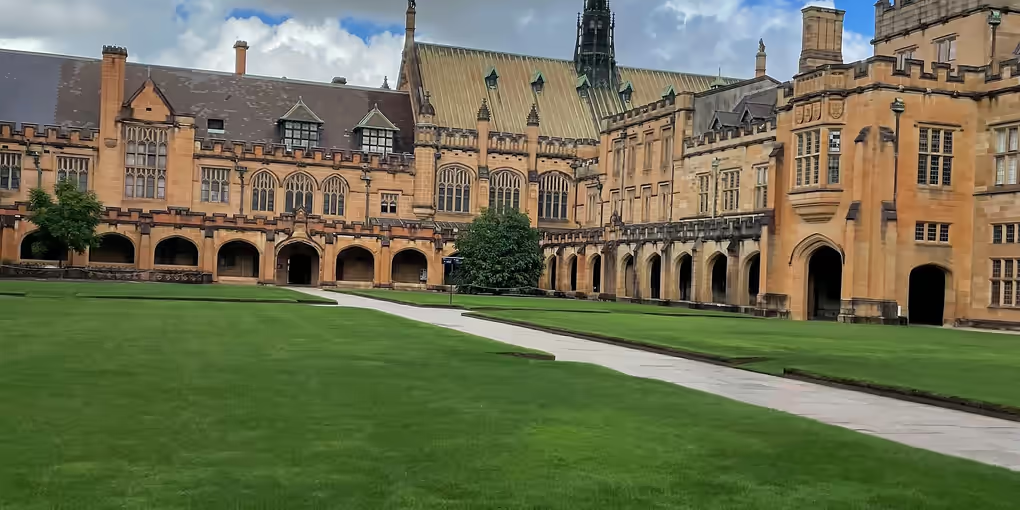
The Camperdown/Darlington precinct is the iconic sandstone-and-modern-buildings campus most families picture: libraries, lecture theatres, colleges and student hubs sit in a dense inner-city university village rather than a remote suburban parkland.
Why location matters for international families
Sydney’s location advantage is real — and so is the cost:
- Students can reach CBD employers, hospitals, studios and tech firms more easily than at outer-suburban campuses
- Housing near Camperdown, Darlington, Newtown and surrounding suburbs is expensive and competitive
- The campus itself is lively and culturally rich, with cafés, societies and city life woven into daily routines
- Families visiting from the Gulf or Southeast Asia will find international flight connections into Sydney straightforward, but should plan accommodation visits carefully given rental scarcity
For GCC and Southeast Asian students, Sydney’s mild climate is generally welcoming; the harder adjustment is usually budgeting and pace, not weather.
Student demographic and culture
The University of Sydney enrols around 75,000 students, with a large international cohort and a strong mix of undergraduate and postgraduate communities. The culture tends to feel:
- Prestigious, diverse and socially busy
- Academically serious, with competitive entry into popular faculties
- City-integrated — student life spills into Newtown, the CBD and the inner west rather than staying behind campus gates
- Well supported through an established international student office, colleges and faculty societies
Male to female balance
Varies clearly by faculty:
- Engineering and Computer Science cohorts lean more male
- Health Sciences, Arts and many Business majors sit closer to balanced or lean female
- Law and Architecture vary by intake but are generally mixed
Who tends to thrive at the University of Sydney
Students who usually do well here are those who:
- Want a prestige Group of Eight brand with broad subject choice
- Are ready for a large, competitive, city-integrated university environment
- Are targeting business, engineering, health, CS, architecture or law
- Can handle Sydney living costs without constant financial stress
- Enjoy building a social life across campus societies and the wider city
Students who prefer a quieter capital, a smaller peer group or a materially lower rent bill may be happier at ANU, Adelaide, Perth or Brisbane options.
Accommodation options
Sydney offers residential colleges, university-affiliated residences and a large private rental market around Camperdown/Darlington. Typical arrangements include:
- Traditional residential colleges with community and pastoral structures
- University-managed or partnered student apartments
- Private share-houses and studios in Newtown, Glebe, Forest Lodge, Chippendale and nearby suburbs
College and near-campus places are competitive. International families should treat accommodation as a parallel application process, not an afterthought once the offer arrives.
Temporary hotel or serviced-apartment stays in the first fortnight are common when permanent leases or college places finalise late — budget for that contingency rather than hoping it will not happen.
Cost and budgeting notes for international families
- Expect premium Sydney rents — often the deciding non-tuition cost for whether Sydney is realistic
- Budget for food, transport and social life at inner-city prices
- Allow for bond, furniture and several weeks of temporary stay if permanent housing is not ready on arrival
- Clinical, architecture studio or placement programmes may add kit, transport or uniform costs
For tuition figures, deposits and scholarships, see Fee structure below.
Fee structure
For GCC and Southeast Asian families, the University of Sydney typically sits in the upper international fee band — commonly A$42,000–A$60,000 per year for undergraduate study, varying widely by faculty. These figures are indicative only; always confirm the latest figures on the official course page and offer letter.
International tuition fees (indicative, 2026/27, in AUD)
| Level | Typical annual tuition |
|---|---|
| Undergraduate — Arts, some Social Sciences | Commonly around A$42,000–A$48,000 per year |
| Undergraduate — Business, Law | Commonly around A$46,000–A$55,000 per year |
| Undergraduate — Engineering, Computer Science, Health, Architecture | Commonly around A$48,000–A$60,000 per year |
| Postgraduate taught | Often around A$44,000–A$68,000 per year (varies widely by programme) |
Useful points for parents:
- Health, Engineering, Architecture and laboratory-based Science generally sit toward the higher end of the range.
- Professional and clinical postgraduate programmes can be priced substantially above undergraduate averages — check the specific programme page.
- Fees typically increase modestly each year of study; the offer letter states the exact schedule.
Deposit, CoE and payment timing
Students needing a Confirmation of Enrolment (CoE) for a Student visa (subclass 500) should expect the University of Sydney to request an initial tuition deposit after accepting an offer. The exact amount and deadline appear in the offer letter.
Families should plan for:
- Offer received (conditional or unconditional)
- Deposit or initial tuition instalment paid by the stated deadline
- CoE issued once payment and any conditions are confirmed
- Student visa (subclass 500) application lodged using the CoE
- Remaining tuition settled by semester through the university’s payment portal
Scholarships and fee reductions (high-level)
The University of Sydney offers international scholarship routes, including:
- Merit-based international scholarships for high-achieving applicants
- Faculty-specific awards across Business, Engineering, Health and Law
- Research scholarships for postgraduate and doctoral candidates
Practical tip: prestige does not mean automatic funding — scholarship windows are competitive and change by intake. Apply early and confirm details through official scholarship communications.
Living costs beyond tuition
Australia’s Department of Home Affairs sets a minimum living-cost financial requirement for the subclass 500 visa. For Sydney, families should budget at the high end of Australian student living estimates for:
- Accommodation for the academic year
- Food, transport and personal expenses
- Overseas Student Health Cover (OSHC), compulsory for the visa
- Course-related materials, studio or placement costs where relevant
- Flights and arrival costs
Admission procedure
Undergraduate applications
Most international undergraduate applicants apply directly to the University of Sydney or through an approved education agent — not through UCAS.
Typical requirements include:
- Completion of secondary schooling to a standard broadly equivalent to Australian Year 12, assessed against Sydney’s country-by-country entry requirements (national GCC/SEA curricula are individually assessed)
- Meeting the course-specific entry standard — Business, Law, Engineering, Health and Architecture pathways can be highly competitive
- Academic transcripts, certificates and passport details
- English language evidence where required
- Prerequisites or additional selection steps for some professional and clinical programmes
English language for most undergraduate courses is commonly around IELTS 6.5 overall (no band below 6.0), with elevated requirements for some education, health and clinical pathways. Always check the exact course page for the intended intake.
Postgraduate applications
Postgraduate taught applications are made directly to the University of Sydney, via the course page or an approved education agent.
Typical requirements include:
- A relevant bachelor’s degree with a competitive grade average
- Academic transcripts and degree certificate
- A CV and personal statement for many programmes
- English language evidence — commonly around IELTS 6.5, higher for some professional or clinical programmes
- Academic references for research-intensive and doctoral applications
Step-by-step pathway for international families
- Shortlist the course — check entry requirements, fees, English thresholds and any portfolio, interview or prerequisite extras.
- Strengthen academics and English early — particularly for Law, Business, Engineering and Health.
- Apply directly or through an approved agent with certified transcripts and supporting documents.
- Receive an offer — conditional or unconditional.
- Accept the offer and pay the required deposit — needed before a CoE can be issued.
- Receive the CoE and apply for the subclass 500 student visa through the Department of Home Affairs.
- Apply for college or near-campus housing immediately — Sydney accommodation scarcity is real.
Intakes and timing
- Semester 1 (February) is the main intake across nearly all undergraduate and most postgraduate programmes.
- A Semester 2 (July) intake is available for many, though not all, courses — always confirm for the specific programme.
- Popular Business, Law and Health programmes can fill ahead of late application windows — early submission is strongly advisable.
Documents checklist (typical)
- Academic transcripts and certificates
- Passport copy
- English language test results (if required)
- Portfolio or supplementary materials where requested (e.g. Architecture)
- CV and personal statement (especially postgraduate applicants)
- Academic references (for research-intensive and doctoral applicants)
- Proof of funds where requested ahead of the formal visa application stage
For GCC and SEA applicants: the University of Sydney publishes detailed grade equivalency guidance by country. Where grades fall short of direct entry, pathway programmes may be available for some subject areas — confirm progression guarantees carefully.
Academic intensity and social life
Academic demands are high across popular faculties. Business programmes emphasise quantitative methods, case work and group projects; Engineering and Computer Science combine lectures with labs and major projects; Health sciences often add placement preparation and professional standards; Architecture is studio-intensive; Law requires heavy reading and formal assessment.
What students can generally expect:
- Large lecture cohorts in high-demand subjects, balanced by tutorials, labs or studios
- A competitive peer environment, especially in Business, Law and STEM
- Strong extracurricular and society culture feeding into both social life and CV-building
- A city-campus rhythm where evenings and weekends often happen off-campus in the inner west and CBD
Social life in practice
Sydney student life is energetic and option-rich: college communities, faculty societies, cultural clubs and the city’s food and arts scenes all compete for time. International students who join one strong society early usually find the campus less overwhelming than those who treat it as a pure commute-to-lectures experience.
The Camperdown/Darlington precinct itself is busy enough that many first-years can build a full social week without travelling far — though CBD internships will still pull ambitious students into the city regularly.
Sports, societies and wider profile
The University of Sydney has one of Australia’s deepest clubs and societies ecosystems:
- Business, consulting, finance and entrepreneurship societies with strong employer links
- Cultural, faith and country-specific societies supporting GCC and Southeast Asian students
- Architecture, design, engineering and health societies tied to professional identity
- Competitive college and university sport, plus recreational fitness on and near campus
For GCC and SEA students, societies are often the fastest route into both friendship groups and internship information — particularly in Business and STEM faculties. College sport and faculty balls also remain part of Sydney’s social fabric in a way that still surprises some international students expecting a purely commuter campus.
Careers and employer reputation
Sydney’s employer reputation is excellent nationally and internationally, helped by both the university brand and the city’s labour market.
Where the University of Sydney can be especially sensible
- Students seeking a prestige Australian degree recognised across the Gulf and Asia-Pacific
- Applicants targeting business, law, health, engineering, CS or architecture with Sydney industry access
- Families who value broad subject choice inside a top-tier university
- Students planning competitive postgraduate or professional study afterward
Where families should be realistic
Prestige does not remove practical constraints. Families should evaluate:
- Whether the full budget — tuition plus Sydney housing — is sustainable for three or more years
- Whether the student’s academic profile is strong enough for competitive faculties
- How placement, clinical or studio requirements affect workload and costs on the specific course
Used well, the University of Sydney works best as a prestige-plus-city-access choice — ideal for strong students who want Australia’s most recognisable university brand in its largest opportunity market. Compared with UNSW, the pitch is often broader prestige and subject breadth rather than a single technology-first identity.
Who should shortlist the University of Sydney?
Consider shortlisting the University of Sydney if your child:
- Wants a globally recognised Group of Eight brand with broad subject choice
- Is interested in business, engineering, health, computer science, architecture or law
- Is ready for a large, competitive, inner-city Sydney university experience
- Has family support for premium living costs across the degree
- Values both academic prestige and city internship access
Consider other options first if your child:
- Needs a quieter or lower-cost capital for a first study-abroad experience
- Prefers a more specialised technology-focused brand such as UNSW for engineering/CS specifically
- Would find a 75,000-student environment anonymous without strong self-direction
How Tutopiya helps
Tutopiya works with students aiming for the University of Sydney and other Australian universities by:
- Strengthening grades in subjects relevant to entry — particularly mathematics, sciences, English, economics and business for Sydney’s most competitive faculties
- Building competitive academic profiles early enough for realistic shortlists among Sydney, Melbourne, UNSW and ANU
- Preparing for English language goals, personal statements, portfolios and interviews where relevant
- Helping families understand fees, deposits, scholarships, CoE timing and subclass 500 visa requirements
- Providing university counselling that weighs prestige, subject fit and Sydney living costs honestly rather than by ranking alone
- Issuing reference letters for tutoring and homeschooling students where Tutopiya has supported the student’s academic programme — useful for direct-entry applications when school references are limited or unavailable
- Connecting families with unpaid internship and work-experience opportunities (where available) to strengthen applications and personal statements before and during the admissions process
If you’d like tailored advice for your child’s situation, you can talk to Tutopiya’s team about a joined-up plan covering both exam preparation and university admissions.
🎓 Free tool
Build your personalised shortlist for University of Sydney →
See entry requirements matched to your own grades, tuition, deadlines and reach/target/safety tiering — free, no signup needed to browse.
Ready to Excel in Your Studies?
Get personalised help from Tutopiya's expert tutors. Whether it's IGCSE, IB, A-Levels, or any other curriculum — we match you with the perfect tutor and your first session is free.
Book Your Free TrialWritten by
Tutopiya Team
Related Articles

Heriot-Watt University Dubai – University Guide for GCC and Southeast Asian Students
Detailed guidance for international students from the Gulf and Southeast Asia considering Heriot-Watt University Dubai, including fees, admissions, campus life, accommodation and graduate outcomes.

University of Birmingham Dubai – University Guide for GCC and Southeast Asian Students
Detailed guidance for international students from the Gulf and Southeast Asia considering University of Birmingham Dubai, including fees, admissions, campus life, accommodation and graduate outcomes.

Abu Dhabi University – University Guide for GCC and Southeast Asian Students
Detailed guidance for international students from the Gulf and Southeast Asia considering Abu Dhabi University (ADU), including fees, admissions, campus life, accommodation and graduate outcomes.