
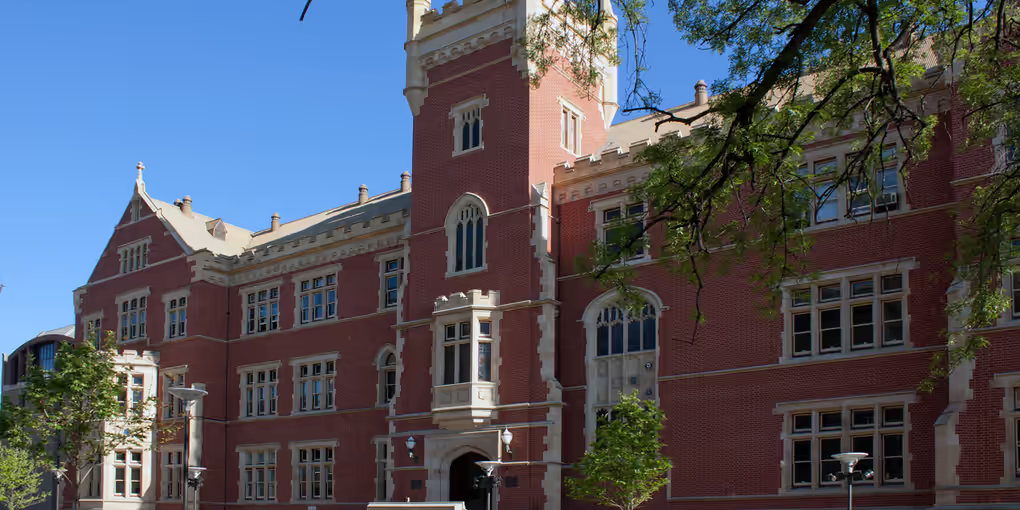
University of South Australia – University Guide for GCC and Southeast Asian Students
Overview
The University of South Australia (UniSA) remains a name GCC and Southeast Asian families type into search engines every week — usually because a relative studied there, an agent brochure still uses the brand, or a ranking screenshot predates 2026. The operational reality for new applicants is different: from January 2026, UniSA and the University of Adelaide opened together as Adelaide University. New offers, CRICOS enrolments and Confirmation of Enrolment documents are issued under that merged public university, not under a standalone UniSA admissions office.
What UniSA was known for — and what still matters when you evaluate Adelaide University programmes descended from it — is a distinctly applied, industry-facing character:
- Engineering — practice-oriented programmes with strong links to South Australian industry
- Business — large, career-focused undergraduate and postgraduate pathways
- Information technology — including applied computing and digital specialisations
- Health sciences — professional and allied-health oriented study
- Design and education — creative and teaching pathways that sat at the heart of UniSA’s campus identity
- International tuition under Adelaide University typically in the A$32,000–A$52,000 band per year for undergraduates (always confirm on the live course page)
Bottom line for 2026 applicants: UniSA is a legacy name, not a separate university you can still join as a new starter. Use this guide to understand the former campuses and strengths, then apply through Adelaide University.
Rankings snapshot (latest major league tables)
UniSA was never marketed as a Group of Eight research giant; its reputation was built on employability, professional accreditation and industry partnerships. Families should read older UniSA rankings in that light.
- Overall global tables — UniSA typically sat outside Australia’s absolute research elite but performed solidly for a large public teaching-and-applied-research university
- Engineering, IT, business, health, design and education — the subject areas where UniSA’s employer recognition was strongest among GCC and SEA applicants
- Graduate outcomes focus — UniSA historically emphasised work-integrated learning, placements and professionally framed degrees
- Adelaide University (from 2026) — the combined institution entered global top-100 reporting (QS around #82 in early combined figures); use Adelaide University’s current subject tables when comparing options today
Practical takeaway for parents: if you liked UniSA because it felt more practical and industry-connected than a pure research brand, that DNA still informs many Adelaide University programmes that grew out of UniSA faculties — but you must verify the 2026 course title, campus and accreditation on the Adelaide University site.
Popular degrees for GCC and Southeast Asian students
Particularly strong and popular for (former UniSA strengths)
- Engineering — applied streams historically delivered with laboratory and industry-project emphasis, including at technology-focused sites such as Mawson Lakes
- Business — a high-volume international choice, often linked to the City West precinct’s professional feel
- Information technology — software, networks and related digital pathways popular with SEA applicants
- Health sciences — nursing and allied-health oriented programmes that attracted Gulf and Asian students seeking professional registration pathways (always confirm current accreditation under Adelaide University)
- Design — studio-based creative degrees that were a distinctive UniSA selling point
- Education — teaching degrees with practicum structures suited to students targeting education careers
Less commonly chosen (from this region)
- Ultra-theoretical pure research doctorates better matched to the former University of Adelaide’s Go8 research culture (now also inside the merged university, but different in flavour)
- Medicine at the scale of Australia’s largest medical schools — check what Adelaide University actually offers rather than assuming UniSA-era options unchanged
- Programmes that only existed at one UniSA campus and may have moved or been redesigned in the merger
Why these courses appeal to GCC and SEA families
- Career-first curriculum design — UniSA’s brand promise was employability, placements and industry briefs, not prestige-for-prestige’s-sake
- Multiple Adelaide study precincts historically (City West, Magill, Mawson Lakes), giving different lifestyle and commute profiles
- Professional fields — IT, health, education, engineering and design — that map cleanly onto career goals many Gulf and SEA families prioritise
- Adelaide cost of living that is typically kinder than Sydney or Melbourne across a full degree
- Continuity through Adelaide University — families can keep the applied-learning preference they associated with UniSA while using the correct 2026 applicant destination
Campus type and location
- City: Adelaide, South Australia
- Legacy UniSA campuses families still search: City West (CBD fringe), Magill (eastern suburbs), Mawson Lakes (northern technology precinct), plus other specialist sites depending on the era
- Type today: those teaching locations feed into the Adelaide University multi-campus network
- Setting: Adelaide metro — from CBD studios and business teaching spaces to suburban education campuses and northern engineering/IT facilities
Campus choice was always the make-or-break detail for UniSA applicants, and it remains essential after the merger. A design student at a city studio precinct and an engineering student at Mawson Lakes did not live the same Adelaide experience — and families should still ask which Adelaide University site hosts the 2026 programme.
Why location matters for international families
- City West suited students who wanted cafés, trams and a professional CBD rhythm
- Magill offered a calmer suburban campus feel, historically popular for education and related fields
- Mawson Lakes leaned technical — engineering and IT students often preferred its facilities and northern Adelaide setting
- Across all sites, Adelaide remains a manageable capital city with lower rents than Sydney and a strong reputation for safety
For GCC and Southeast Asian students, Adelaide’s dry summers and mild winters are usually an easier climate story than cold inland NSW towns — though summer heat still requires air-conditioned housing plans. Families comparing Adelaide with Brisbane or Perth should also note that South Australia’s calendar of festivals and food culture gives international students a surprisingly rich weekend life for a mid-sized capital.
Student demographic and culture
UniSA’s on-campus culture was typically described as pragmatic, diverse and career-minded rather than collegiate-ivy. Large international cohorts in business, IT and health sat alongside domestic students focused on professional qualifications. That applied ethos continues inside Adelaide University programmes that inherited UniSA faculties, now within a bigger combined student body of roughly 70,000 across the merged institution.
Expect:
- A strong international presence, including established Southeast Asian and Gulf communities in Adelaide
- More “professional school” energy in business, IT, health and design than classic sandstone tutorial culture
- Clubs and societies organised around faculties and careers as much as around residential colleges
- A city lifestyle that still lets students balance study with part-time work more easily than in Australia’s most expensive capitals
Male to female balance
Varies sharply by field:
- Engineering and IT lean more male
- Education, nursing and many health programmes lean more female
- Business and design sit closer to balanced, depending on the specialisation
Who tends to thrive on the UniSA-heritage pathway
Students who usually do well are those who:
- Prefer applied projects, placements and industry briefs over purely theoretical study
- Are targeting engineering, business, IT, health, design or education
- Care which Adelaide campus precinct they will actually attend day to day
- Are organised enough to follow merger transition details on course pages and offer letters
- Want Adelaide’s lifestyle without pretending UniSA still operates as a separate applicant university
Students who only want a classic Go8 sandstone narrative may gravitate toward Adelaide University programmes descended from the former University of Adelaide — still the same legal university, but a different academic flavour within it.
Accommodation options
Housing strategy depends heavily on which former UniSA precinct (now Adelaide University site) delivers the course:
- CBD / City West students often use purpose-built student towers and share-flats in the city
- Magill students commonly rent in Adelaide’s eastern suburbs for a shorter commute
- Mawson Lakes students typically look north, sometimes relying more on buses or a car
University-linked and private purpose-built student accommodation options serve Adelaide’s international intake; early booking for Semester 1 remains wise. Students who lock housing near the wrong precinct often end up with long daily commutes — a common mistake when families still think in terms of “UniSA Adelaide” as a single campus.
Cost and budgeting notes for international families
- Adelaide living costs are generally below Sydney and Melbourne, which stretches the family budget across engineering or health degrees that sit at higher tuition bands
- Northern or outer-suburban campuses can add transport costs if students insist on living in the CBD
- Include OSHC, textbooks/studio materials (design) and placement-related expenses (education, health) in the plan
- Occasional interstate flights for family visits should be budgeted separately
For tuition figures, deposits and scholarships, see Fee structure below — always on Adelaide University documents, not archived UniSA fee tables.
Fee structure
For new international students, fees are published by Adelaide University. As an indicative planning band for GCC and Southeast Asian families: roughly A$32,000–A$52,000 per year for undergraduate study and A$34,000–A$58,000 for many postgraduate taught programmes. Always confirm the exact AUD amount on the official course page and offer letter.
International tuition fees (indicative, 2026/27, in AUD)
| Level | Typical annual tuition |
|---|---|
| Undergraduate — Business, Education, many classroom programmes | Commonly around A$32,000–A$40,000 per year |
| Undergraduate — IT, Design | Commonly around A$36,000–A$46,000 per year |
| Undergraduate — Engineering, laboratory Health sciences | Commonly around A$42,000–A$52,000 per year |
| Postgraduate taught | Often around A$34,000–A$58,000 per year (varies by programme) |
Useful points for parents:
- Studio, lab and clinical programmes usually cost more than pure classroom business degrees.
- Discard pre-2026 UniSA fee PDFs when budgeting — pricing authority sits with Adelaide University.
- Scholarship stacking rules and payment instalments appear in the offer pack; read them carefully.
Deposit, CoE and payment timing
A Confirmation of Enrolment (CoE) for the Student visa (subclass 500) is issued by Adelaide University after you accept an eligible offer and meet payment/condition requirements.
Families should plan for:
- Offer received from Adelaide University (naming the correct campus and course)
- Deposit paid by the deadline in the offer letter
- CoE issued once conditions are cleared
- Subclass 500 visa application lodged with that CoE
- Ongoing tuition paid by semester through the university portal
Scholarships and fee reductions (high-level)
International scholarship routes under Adelaide University include merit awards and faculty-linked support that continue themes UniSA historically promoted — employability, equity and academic achievement. Amounts and deadlines change by intake; treat published figures as guides only.
Practical tip: apply early if your child’s grades sit near scholarship thresholds — merger-year competition for popular business, IT and engineering places can be real.
Living costs beyond tuition
Budget beyond tuition for:
- Rent matched to the actual campus precinct
- Food, transport and personal costs
- Compulsory OSHC
- Placement uniforms, police checks or studio materials where relevant
- Flights and settling-in costs
Australia’s visa financial-evidence rules still apply even when Adelaide’s street-level costs feel lower than Sydney’s.
Admission procedure
Undergraduate applications
International undergraduates apply directly to Adelaide University or via an approved education agent. Australian universities do not use UCAS. There is no separate UniSA new-applicant channel for 2026 starters.
Typical requirements include:
- Year 12–equivalent secondary completion, assessed against Adelaide University’s country equivalencies
- Course-specific prerequisites (mathematics for many engineering/IT routes; portfolios for some design degrees)
- Transcripts, certificates and passport bio-page
- English evidence where required — commonly around IELTS 6.5 overall for many programmes (confirm per course; some health and education routes sit higher)
Postgraduate applications
Postgraduate taught applications go directly to Adelaide University.
Typical requirements include:
- A relevant bachelor’s degree at the stated grade level
- Transcripts, CV and often a personal statement
- English around IELTS 6.5 for many courses, higher for selected professional programmes
- Extra checks for teaching, nursing or clinical pathways (including character/health clearances later in the process)
Step-by-step pathway for international families
- Start from the UniSA name if that is what you know, then locate the equivalent Adelaide University course for 2026.
- Confirm campus precinct — City West heritage, Magill, Mawson Lakes or another site — before you fall in love with a course title alone.
- Apply directly or through an approved agent with certified documents.
- Receive and assess the offer — check tuition in AUD, English conditions and start date.
- Accept and pay the deposit to unlock CoE processing.
- Use the CoE for the subclass 500 visa.
- Book housing near the teaching campus, not just “somewhere in Adelaide.”
Intakes and timing
- Semester 1 (February/March) is the primary intake.
- Semester 2 (July) runs for many business, IT and selected other programmes.
- Professional degrees with placements can have earlier documentation deadlines — build slack into the timeline.
Documents checklist (typical)
- Academic transcripts and completion certificates
- Passport copy
- English test results (if required)
- Portfolio (selected design programmes)
- CV / statement (especially postgraduate)
- Proof of funds for visa stage
For GCC and SEA applicants: if grades miss direct entry, ask Adelaide University about foundation or diploma pathways that articulate into the intended degree — and confirm whether that pathway still uses a campus location you are happy with.
Academic intensity and social life
UniSA-heritage programmes tend to feel busy in a practical way: engineering students juggle labs and industry projects; IT students ship group builds; design cohorts live in studio critique cycles; education and health students balance coursework with placement blocks. Assessment often weights applied outputs — reports, prototypes, teaching portfolios, clinical competencies — alongside exams.
What students can generally expect:
- Clear professional framing of assignments
- Group work that mirrors workplace collaboration
- Placement or work-integrated learning in many degrees
- A social life split between campus societies and Adelaide city culture
Social life in practice
Because UniSA’s campuses were spread across Adelaide, friendship groups often formed inside the home campus first. That remains true after the merger: a Mawson Lakes engineering cohort will not automatically socialise like a City West business cohort. International students who join faculty clubs early usually settle faster than those who wait for “the city” to provide a social life by itself.
Sports, societies and wider profile
The UniSA student experience historically featured:
- Campus sport and gym access scaled to each precinct
- Strong faculty societies in business, engineering, IT, design and education
- Cultural and faith groups reflecting Adelaide’s international student mix
- Industry evenings, hackathons and portfolio showcases that doubled as networking
For GCC and SEA students, a faculty society plus one cultural society is often the simplest formula for both belonging and CV-building.
During festival season and mid-year intakes, Adelaide’s international office and student associations usually run orientation programmes that are worth attending even if your child already feels confident socially — they are one of the fastest ways to meet other new arrivals from the Gulf and Southeast Asia.
Placement-heavy degrees in education and health also benefit from early calendar planning, because practicum blocks can clash with family travel if left to the last minute.
Careers and employer reputation
UniSA’s employer brand in Australia was strongest where degrees were professionally recognisable: engineering, IT, nursing/health, teaching, design and business. Graduates completing Adelaide University awards that continue those programmes should emphasise placements, tools and accreditation on applications, and be precise about the awarding university name on formal documents.
Where this pathway can be especially sensible
- Students who want applied learning and clearer links to workplaces during the degree
- Families prioritising professional fields over pure research prestige
- Applicants who specifically want Magill, City West or Mawson Lakes-style study settings inside Adelaide
- Households comparing Adelaide favourably on cost of living versus Sydney or Melbourne
Where families should be realistic
- UniSA is not an independent 2026 applicant destination
- Course names, campuses and accreditations may have shifted in the merger — verify each one
- Adelaide’s job market is excellent in many state-linked sectors but is not identical to Sydney’s finance or Melbourne’s creative density
Used well, a UniSA search becomes a focused Adelaide University shortlist with the right campus and the right professional degree — not a nostalgic application to a closed portal. Parents can still talk about UniSA’s applied reputation with relatives; the paperwork simply names Adelaide University.
Treat any pre-2026 UniSA offer letter, fee schedule or agent brochure as historical context only.
Ask Adelaide University which former UniSA campus precinct delivers your child’s intended units before booking flights or housing.
That one question prevents most of the housing and timetable surprises families encounter in the first month.
Who should shortlist the University of South Australia (via Adelaide University)?
Consider this pathway if your child:
- Originally shortlisted UniSA for its applied, industry-focused reputation
- Is interested in engineering, business, IT, health, design or education
- Cares about studying at a particular Adelaide precinct (city, Magill or Mawson Lakes heritage)
- Wants Adelaide living costs with a professional-degree emphasis
- Is ready to submit applications to Adelaide University for 2026+
Consider other options first if your child:
- Needs a university that still enrols new students under the UniSA legal name alone
- Wants a classic Go8-only research narrative without checking which Adelaide University programme actually fits
- Requires a larger east-coast metro internship market from the first semester
How Tutopiya helps
Tutopiya works with students aiming for Adelaide University (including families who first searched UniSA / University of South Australia) and other Australian universities by:
- Strengthening grades in mathematics, sciences, English and portfolio-ready subjects linked to engineering, IT, business, design, health and education entry
- Building realistic Australian shortlists that account for the 2026 merger
- Preparing for English targets and direct applications (not UCAS)
- Explaining AUD fees, deposits, CoE issuance and subclass 500 visa timing
- Providing university counselling that matches students to the right Adelaide campus precinct, not just a brand name
- Issuing reference letters for tutoring and homeschooling students where Tutopiya has supported the student’s academic programme — useful for direct-entry applications when school references are limited or unavailable
- Connecting families with unpaid internship and work-experience opportunities (where available) to strengthen applications before and during the admissions process
If you’d like tailored advice for your child’s situation, you can talk to Tutopiya’s team about a joined-up plan covering both exam preparation and university admissions.
🎓 Free tool
Build your personalised shortlist for University of South Australia →
See entry requirements matched to your own grades, tuition, deadlines and reach/target/safety tiering — free, no signup needed to browse.
Ready to Excel in Your Studies?
Get personalised help from Tutopiya's expert tutors. Whether it's IGCSE, IB, A-Levels, or any other curriculum — we match you with the perfect tutor and your first session is free.
Book Your Free TrialWritten by
Tutopiya Team
Related Articles

Heriot-Watt University Dubai – University Guide for GCC and Southeast Asian Students
Detailed guidance for international students from the Gulf and Southeast Asia considering Heriot-Watt University Dubai, including fees, admissions, campus life, accommodation and graduate outcomes.

University of Birmingham Dubai – University Guide for GCC and Southeast Asian Students
Detailed guidance for international students from the Gulf and Southeast Asia considering University of Birmingham Dubai, including fees, admissions, campus life, accommodation and graduate outcomes.

Abu Dhabi University – University Guide for GCC and Southeast Asian Students
Detailed guidance for international students from the Gulf and Southeast Asia considering Abu Dhabi University (ADU), including fees, admissions, campus life, accommodation and graduate outcomes.