
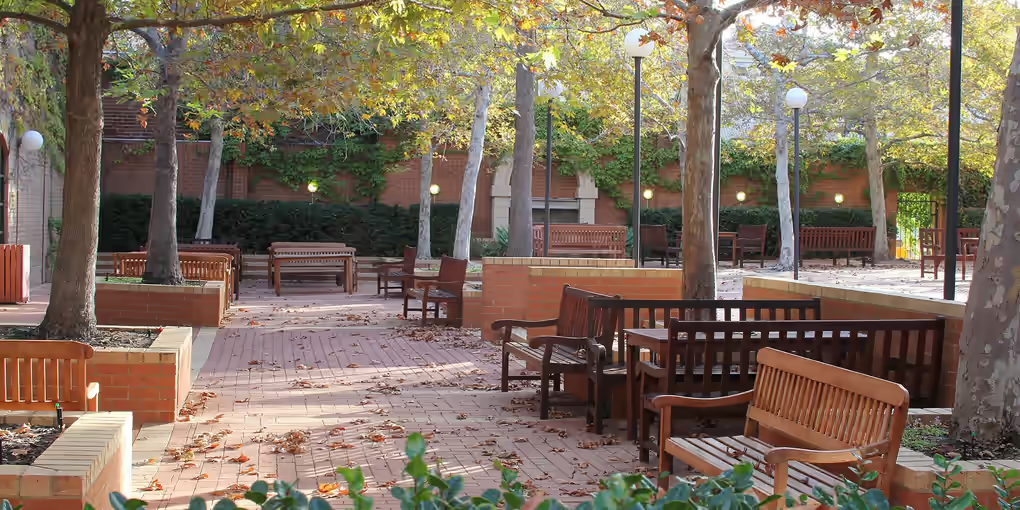
University of Notre Dame Australia – University Guide for GCC and Southeast Asian Students
Overview
The University of Notre Dame Australia is a private Catholic university of roughly 12,000 students, best known for smaller cohorts and professional programmes across Fremantle (main campus, historic coastal Perth), Sydney and Broome. For GCC and Southeast Asian families, it occupies a different niche from both giant public universities and purely theological colleges: Catholic ethos, personal teaching scale, and serious professional schools in health, education, law and business.
International interest usually concentrates on:
- Medicine and health sciences — including competitive medicine entry that must be treated as a separate process
- Nursing and physiotherapy — clinically framed degrees with placement demands
- Education — teaching pathways inside a values-based community
- Law and business — smaller-cohort professional study than mega-law and mega-business schools
- International undergraduate tuition commonly around A$30,000–A$45,000 per year (always confirm course and campus; medicine and some health programmes sit apart)
Families who want a Catholic, smaller-cohort Australian university with genuine professional depth — especially in health — often find Notre Dame worth a dedicated shortlist conversation.
Rankings snapshot (latest major league tables)
Notre Dame Australia is not primarily marketed through a single global ranking position. Parents usually weigh:
- Professional school reputation in medicine, nursing, physiotherapy, education and law relative to cohort size
- Teaching quality and student support commentary that reflects smaller classes
- Catholic university identity recognised by families comparing values-based options such as ACU — while noting Notre Dame’s different campus map and course mix
- Graduate readiness for registration pathways in health and teaching, which matters more than overall QS band for many applicants
Practical takeaway for parents: evaluate Notre Dame through the professional school and campus your child would actually join. Medicine especially cannot be inferred from general undergraduate entry advice.
Popular degrees for GCC and Southeast Asian students
Particularly strong and popular for
- Medicine — highly competitive, with separate selection requirements beyond standard undergraduate admission
- Nursing — a core international pathway with clinical placements
- Physiotherapy and broader health — strong interest from families targeting allied health careers
- Education — teaching degrees aligned with Notre Dame’s formative ethos
- Law and business — smaller professional cohorts than Australia’s largest city law/business faculties
Less commonly chosen (from this region)
- Large-scale engineering or research-intensive pure sciences better matched to Go8 laboratories
- Fashion or commercial creative industries that depend on eastern-seaboard studio ecosystems
- Broad exploratory arts degrees when the family specifically wants Notre Dame’s professional strengths
Why these courses appeal to GCC and SEA families
- Smaller cohorts create closer clinical and tutorial supervision than many large public universities
- Catholic ethos can feel culturally familiar to Christian families from the Gulf and Southeast Asia, while remaining open to students of other backgrounds who respect community values
- Fremantle’s coastal setting offers a distinctive, walkable alternative to anonymous CBD campuses
- Sydney campus options give access to Australia’s largest employment market for selected programmes
- Professional degrees map onto clear post-study registration or career narratives when requirements are met
Campus type and location
- Fremantle, Western Australia: main historic coastal campus near Perth — sandstone streets, harbour character, compact student footprint
- Sydney: eastern-states professional and health-linked options for selected courses
- Broome: a smaller, distinctive Kimberley presence with different programme availability
- Type: Private Catholic multi-campus university
- Planning rule: course and campus combinations differ substantially — confirm before applying
Fremantle is the lifestyle story many families fall in love with: coastal, historic, human-scale. Sydney is the opportunity story for certain programmes. Broome is specialist and should never be assumed interchangeable with Fremantle.
Why location matters for international families
- Fremantle/Perth living costs are often more manageable than Sydney, with a sunny outdoor lifestyle
- Perth’s geographic distance from Australia’s east coast is real — flights home via Asia can still be convenient for many GCC/SEA families, but east-coast weekend hopping is not casual
- Sydney raises both career density and rent
- Broome is remote relative to major metros — only suitable when the specific programme belongs there
For GCC and Southeast Asian students, the emotional pull of Fremantle should be checked against the cold logistics of course availability and career networks.
Perth’s time zone and flight patterns also matter for family contact: many Gulf and Southeast Asian routes connect efficiently through Asian hubs, which some families prefer to multi-leg east-coast itineraries. Still, relatives based in Sydney or Melbourne will find Fremantle a longer domestic hop than an east-coast university — factor visit frequency into the lifestyle decision.
Student demographic and culture
Around 12,000 students nationally keeps Notre Dame more personal than Australia’s largest universities. Culture tends to feel:
- Explicitly Catholic in identity, with chaplaincy and ethics woven into university life, while welcoming students of other faiths who engage respectfully
- Professionally focused — many peers are already oriented to medicine, health, teaching or law
- Community-minded, with smaller tutorial and clinical groups
- Coastal and outdoor-oriented at Fremantle in particular
Male to female balance
Varies by school:
- Nursing and Education often lean female
- Medicine and health sciences are competitive mixed cohorts
- Law and business tend toward more balanced intakes
- Physiotherapy is often relatively mixed with course-specific patterns
Who tends to thrive at Notre Dame Australia
Students who usually do well are those who:
- Want smaller professional cohorts rather than mega-faculty anonymity
- Are comfortable in — or respectful of — a Catholic university culture
- Have clear interest in medicine, health, nursing, physiotherapy, education, law or business
- Like Fremantle’s coastal pace or have a deliberate reason to choose Sydney/Broome
- Can handle the extra competitiveness and compliance load of clinical programmes
Students seeking a large secular research university with endless society density may prefer UWA, UNSW or similar alternatives depending on city.
Accommodation options
Housing options differ by campus:
- Fremantle students often use university-linked residences, local share houses or Perth-corridor rentals with a commute trade-off
- Sydney students compete in a tighter, more expensive rental market near teaching sites
- Broome housing needs early, campus-specific planning because the local market is smaller
First-year internationals usually benefit from university-recommended housing lists rather than arriving without a lead.
In Fremantle, walking-distance housing is prized and can book out before semester; some students accept a short Perth-train commute in exchange for better rent. In Sydney, start the search as soon as the offer is firm. In Broome, contact the campus early enough that limited local supply does not force rushed decisions.
Cost and budgeting notes for international families
- Fremantle/Perth budgets are typically kinder than Sydney for equivalent lifestyles
- Medicine, nursing and physiotherapy students must budget for immunisations, checks, uniforms and placement travel
- OSHC is compulsory for subclass 500 visa holders
- Allow for WA’s outdoor lifestyle costs (transport around Perth, occasional coastal travel) without underestimating textbooks and clinical gear
- Sydney campus families should model rent with the same seriousness as tuition
For tuition figures, deposits and scholarships, see Fee structure below.
Fee structure
For GCC and Southeast Asian families, Notre Dame Australia commonly sits around A$30,000–A$45,000 per year for many undergraduate international programmes, with postgraduate taught study often around A$32,000–A$52,000. Medicine and some health degrees can sit outside simple undergraduate averages. Figures are indicative — always confirm on the official course page and offer letter for the relevant campus.
International tuition fees (indicative, 2026/27, in AUD)
| Level | Typical annual tuition |
|---|---|
| Undergraduate — Business, Education, Arts-linked pathways | Commonly around A$30,000–A$36,000 per year |
| Undergraduate — Nursing, Law, selected Health | Commonly around A$33,000–A$42,000 per year |
| Undergraduate — Physiotherapy and premium health streams | Commonly around A$38,000–A$45,000 per year |
| Medicine / selected postgraduate professional programmes | Confirm separately — often materially higher and intake-specific |
| Postgraduate taught | Often around A$32,000–A$52,000 per year |
Useful points for parents:
- Clinical programmes add non-tuition compliance and equipment costs.
- Campus-specific fee schedules can differ for the same field.
- Medicine applicants should request a dedicated cost sheet covering the full degree length.
Deposit, CoE and payment timing
After accepting an eligible offer and satisfying conditions, students obtain a Confirmation of Enrolment (CoE) for the Student visa (subclass 500). A deposit or initial tuition payment is typically required first.
Families should plan for:
- Campus- and course-specific offer (especially important for medicine/health)
- Deposit paid by the stated deadline
- CoE issued once conditions are met
- Subclass 500 visa application lodged
- Ongoing tuition paid per Notre Dame’s instalment schedule
Scholarships and fee reductions (high-level)
Possible supports include:
- International merit scholarships for strong academic profiles
- Faculty or campus awards in health, education or law in some intakes
- Early-acceptance incentives when advertised
Practical tip: medicine and competitive health offers may follow different scholarship calendars than general undergraduate rounds — ask the faculty office directly.
Living costs beyond tuition
Budget separately for:
- Rent in Fremantle/Perth, Sydney or Broome as applicable
- Food, transport and personal expenses
- OSHC
- Clinical placement costs
- Flights (Perth–Asia routes are often convenient for many GCC/SEA families)
Medicine and physiotherapy families should also ask for a year-by-year cost sketch, because clinical years can change placement travel and equipment needs relative to the first year.
Admission procedure
Undergraduate applications
Most international undergraduates apply directly to The University of Notre Dame Australia or through an approved agent — not through UCAS.
Typical requirements include:
- Year-12-equivalent secondary results assessed against Notre Dame equivalency guidance
- Course-specific academic thresholds — health and law are more competitive than some general programmes
- Transcripts, passport details and supporting documents
- English evidence — commonly around IELTS 6.5 overall (no band below 6.0), with higher scores for many education, nursing and health courses
- For teaching and health, early planning for checks and immunisations
Medicine note: medicine uses a separate competitive entry process (additional testing, interviews and prerequisite rules may apply). Do not treat it as a standard direct-entry undergraduate offer.
Postgraduate applications
Postgraduate taught applications are usually direct and may require:
- A relevant bachelor’s degree and competitive GPA
- Transcripts, CV and references
- English evidence around IELTS 6.5, frequently higher for education, nursing and clinical pathways
- Interviews or supplementary forms for some professional schools
Step-by-step pathway for international families
- Confirm campus and course pairing — Fremantle, Sydney or Broome.
- Separate medicine applicants into a dedicated timeline with testing and interview milestones.
- Strengthen academics and English early, especially for health and law.
- Apply directly or via an approved agent.
- Accept the offer, pay the deposit and receive the CoE.
- Lodge the subclass 500 visa.
- Arrange housing and clinical compliance paperwork before semester starts.
Intakes and timing
- Semester 1 (February) is the main intake for most programmes.
- Semester 2 (July) is available for some, not all, courses.
- Medicine and competitive health timelines can run earlier and tighter than general rounds.
Documents checklist (typical)
- Academic transcripts and certificates
- Passport copy
- English test results
- Supplementary medicine/health forms where relevant
- Immunisation and background-check planning documents for clinical courses
- Proof of funds for visa purposes
For GCC and SEA applicants: country equivalency plus English band requirements are the usual gates. For medicine, expect additional selection layers regardless of strong school grades.
Academic intensity and social life
Academic intensity is highest in medicine, physiotherapy and nursing, where contact hours, labs and placements stack quickly. Education blends coursework with school practicums; law and business follow more familiar seminar and assessment patterns but still benefit from Notre Dame’s smaller groups.
What students can generally expect:
- Closer staff access than at many large public universities
- Ethics and reflective components linked to the Catholic intellectual tradition
- Placement-heavy calendars in health and education
- A Fremantle social scene built around campus, harbour suburbs and Perth day trips
Social life in practice
Fremantle students often describe an easier time forming friendships because cohorts are visible and the town is walkable. Sydney students plug into a larger city network with more distraction and opportunity. Either way, clinical students should expect social life to flex around placement rosters.
Fremantle’s cafes, waterfront and compact streets make informal socialising easy when the timetable allows; the risk is underestimating how quickly placement blocks and exam periods shrink free evenings. Students who schedule one recurring non-academic commitment — sport, music, service or a faith group — usually protect balance better than those who wait until “after this rotation.”
Sports, societies and wider profile
Notre Dame’s extracurricular profile matches a mid-sized Catholic university:
- University sport and recreational clubs, stronger where campus facilities support them
- Faith, service and justice-oriented student groups alongside standard cultural societies
- Professional associations for medicine, nursing, law and education students
- Community engagement activities that reflect Catholic social teaching
For GCC and SEA students, professional society membership plus one service or faith community group is usually the fastest dual track into friends and mentors.
Competitive health applicants should also watch faculty open days and information webinars carefully — selection advice for medicine and allied health is updated more often than general undergraduate pages.
Careers and employer reputation
Employer recognition is strongest in medicine, nursing, physiotherapy, teaching, law and business, especially where graduates are known for professional readiness and ethical formation.
Where Notre Dame can be especially sensible
- Students targeting medicine or allied health who want smaller cohorts and intensive support
- Applicants seeking nursing, education, law or business inside a Catholic university culture
- Families drawn to Fremantle’s coastal setting or needing a Sydney campus option for a specific programme
- Students who thrive when staff know them and pastoral care is visible
Where families should be realistic
- Medicine is a separate competitive contest — interest alone is not a plan
- Not every programme runs at every campus
- Research-intensity and mega-campus society life are not Notre Dame’s main selling points
Used well, Notre Dame Australia is a Catholic professional-school choice with a distinctive Fremantle heart — strongest when vocation, campus and entry pathway are aligned from the start. Families comparing it with ACU should note the different campus map, the medicine pathway question, and Fremantle’s coastal identity; both can be values-based choices without being interchangeable.
Who should shortlist The University of Notre Dame Australia?
Consider shortlisting Notre Dame if your child:
- Is focused on medicine, nursing, physiotherapy, health, education, law or business
- Wants smaller cohorts and a visible pastoral/Catholic university culture
- Prefers Fremantle’s historic coastal setting, or has a confirmed Sydney/Broome programme reason
- Is prepared for competitive or compliance-heavy entry in clinical fields
- Values ethical formation alongside professional training
Consider other options first if your child:
- Wants a large secular Go8 research environment above all else
- Needs a course Notre Dame does not offer at the preferred campus
- Is not ready for the separate competitiveness of medicine entry but will not consider alternative health pathways
How Tutopiya helps
Tutopiya works with students aiming for The University of Notre Dame Australia and other Australian universities by:
- Strengthening sciences, English and mathematics for health, nursing and medicine-related pathways
- Building realistic timelines for standard direct entry versus competitive medicine selection
- Preparing for English language goals, interviews and application documents
- Helping families interpret AUD fees, deposits, scholarships and CoE steps for the subclass 500 visa
- Providing counselling that weighs Catholic campus culture, city choice and professional outcomes together
- Issuing reference letters for tutoring and homeschooling students where Tutopiya has supported the academic programme
- Connecting families with unpaid internship and work-experience opportunities (where available) to strengthen health, education and professional applications
If you’d like tailored advice for your child’s situation, you can talk to Tutopiya’s team about a joined-up plan covering both exam preparation and university admissions.
🎓 Free tool
Build your personalised shortlist for The University of Notre Dame Australia →
See entry requirements matched to your own grades, tuition, deadlines and reach/target/safety tiering — free, no signup needed to browse.
Ready to Excel in Your Studies?
Get personalised help from Tutopiya's expert tutors. Whether it's IGCSE, IB, A-Levels, or any other curriculum — we match you with the perfect tutor and your first session is free.
Book Your Free TrialWritten by
Tutopiya Team
Related Articles

Heriot-Watt University Dubai – University Guide for GCC and Southeast Asian Students
Detailed guidance for international students from the Gulf and Southeast Asia considering Heriot-Watt University Dubai, including fees, admissions, campus life, accommodation and graduate outcomes.

University of Birmingham Dubai – University Guide for GCC and Southeast Asian Students
Detailed guidance for international students from the Gulf and Southeast Asia considering University of Birmingham Dubai, including fees, admissions, campus life, accommodation and graduate outcomes.

Abu Dhabi University – University Guide for GCC and Southeast Asian Students
Detailed guidance for international students from the Gulf and Southeast Asia considering Abu Dhabi University (ADU), including fees, admissions, campus life, accommodation and graduate outcomes.