
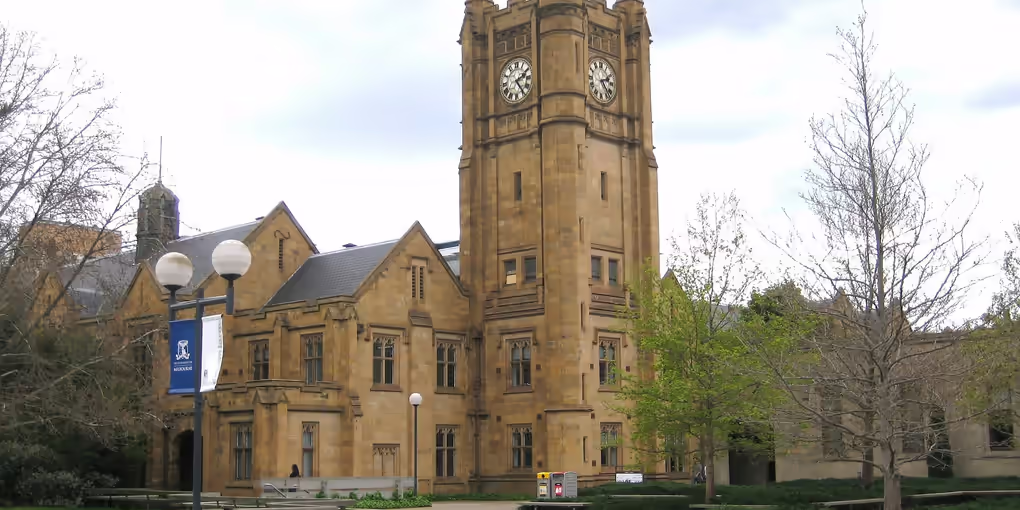
University of Melbourne – University Guide for GCC and Southeast Asian Students
Overview
The University of Melbourne is Australia’s most internationally decorated university and the country’s clearest prestige pick in most global rankings, sitting at #19 in the QS World University Rankings 2026 — the highest of any Australian institution. Its main Parkville campus sits just north of Melbourne’s CBD, in a precinct shared with major teaching hospitals and research institutes, giving the university a genuinely metropolitan feel that suits families who want a global city experience attached to a globally recognised name.
Melbourne is best known internationally for:
- The Melbourne Model — a distinctive curriculum structure explained in detail below, built around broad undergraduate degrees followed by professional graduate study
- Law — Melbourne Law School is consistently ranked among the world’s best, with its Juris Doctor (JD) a leading graduate-entry law qualification
- Medicine — taught through a graduate-entry Doctor of Medicine (MD), following an undergraduate degree such as Biomedicine
- Business and economics — the Melbourne Business School and undergraduate Commerce degree carry strong regional employer recognition
- Arts, humanities and social sciences — among the most comprehensive and research-active in Australia
- International tuition typically in the A$40,000–A$58,000 band per year depending on the programme (always confirm the exact figure on the official course page)
Families seeking the strongest possible global prestige signal from an Australian degree, and comfortable with a graduate-entry pathway into professional degrees, tend to find Melbourne the standout choice.
Understanding the Melbourne Model (essential reading before you apply)
Unlike most Australian and UK universities, Melbourne does not offer direct undergraduate entry into Medicine, Law or several other professional degrees. Instead, it uses the Melbourne Model:
- Students first complete a broad three-year undergraduate degree — commonly the Bachelor of Biomedicine, Bachelor of Commerce, Bachelor of Arts or Bachelor of Science
- During this degree, students choose a major and build the academic profile and prerequisites needed for their intended professional pathway
- Entry into graduate professional degrees — the Doctor of Medicine (MD), Juris Doctor (JD), Master of Teaching and others — is then competitive, based on undergraduate results, admissions tests (such as the GAMSAT for medicine or LSAT-equivalent assessments for some law entry routes) and, in some cases, interviews
For GCC and Southeast Asian families used to direct-entry medicine or law degrees straight from secondary school, this is the single most important structural difference to understand before shortlisting Melbourne. The trade-off is real: it adds years and cost to reach a professional qualification, but it also gives students a genuine “insurance” degree and the flexibility to change direction after first-year exposure to university-level study.
Practical takeaway for parents: if your child has a firm, unwavering ambition to study medicine or law, compare the total time and cost of Melbourne’s graduate-entry pathway against direct-entry alternatives at other Go8 universities before deciding — both are valid, but they suit different risk appetites and family planning horizons.
Rankings snapshot (latest major league tables)
Melbourne’s #19 global QS ranking is Australia’s strongest, and its subject-level performance backs this up broadly:
- Law — regularly ranked among the world’s top 10–15 law schools
- Education — consistently rated the strongest education faculty in Australia, and among the world’s best
- Medicine and biomedical sciences — top-tier research output and clinical training through affiliated teaching hospitals
- Accounting and finance / business and management — strong global rankings, reinforced by a large and well-connected alumni network across Asia
- Arts, humanities and social sciences — among the broadest and most research-active offerings of any Australian university
Practical takeaway for parents: Melbourne’s overall ranking is unusually consistent with its subject rankings — a rare case where the headline number and the department-level reality tell the same story.
Popular degrees for GCC and Southeast Asian students
Particularly strong and popular for
- Bachelor of Biomedicine — the standard first step toward graduate-entry Medicine (MD), and a strong standalone science degree in its own right
- Bachelor of Commerce — broad, employable, and a direct pipeline into Melbourne Business School’s postgraduate offerings
- Bachelor of Arts (with Law-adjacent majors) — commonly paired with a later Juris Doctor for students set on a legal career
- Bachelor of Science (Engineering major) — followed by the Master of Engineering, Melbourne’s graduate-entry engineering pathway
- Master of Teaching and postgraduate education degrees — reflecting the faculty’s strong reputation
- Melbourne Business School MBA and postgraduate finance programmes — popular with students returning for a second Australian qualification
Less commonly chosen (from this region)
- Direct-entry medicine or law straight from secondary school — Melbourne does not offer this route (see the Melbourne Model above)
- Highly vocational or trade-adjacent diplomas, which are better served by dedicated TAFE or polytechnic providers
- Niche performing-arts conservatoire training better matched to specialist institutions
Why these courses appeal to GCC and SEA families
- Melbourne’s global brand recognition is arguably the strongest of any Australian university, which matters for families weighing long-term international mobility
- The Melbourne Model’s flexibility appeals to families who want their child to keep options open before committing to a specific professional path
- Melbourne Business School and Melbourne Law School carry genuine weight with employers across Asia and the Gulf
- A large, well-established alumni network across Southeast Asia in particular, useful for networking and mentorship
- Melbourne’s reputation as Australia’s cultural and culinary capital appeals to families wanting a metropolitan experience alongside study
Campus type and location
- City: Melbourne, Victoria
- Type: Inner-city campus (Parkville) integrated with a major hospital and biomedical research precinct
- Setting: Around 3km north of the Melbourne CBD, connected by tram, and within walking distance of the Royal Melbourne, Royal Children’s and Royal Women’s Hospitals
Parkville is one of Australia’s most concentrated research and health precincts, giving science and medicine-track students direct proximity to major hospitals and research institutes from day one.
Why location matters for international families
- Melbourne is consistently rated among the world’s most liveable cities, with an exceptional food, arts and cultural scene
- The city has a genuine four-season climate — noticeably cooler winters than Brisbane or the Gulf, which GCC and Southeast Asian families should plan for with appropriate clothing
- Melbourne’s tram network makes the university and CBD easy to navigate without a car
- Living costs sit at the higher end of Australian cities, broadly comparable to or slightly below Sydney
- The city’s large, established Southeast Asian and South Asian communities make everyday life — food, faith communities, cultural events — noticeably easier for new arrivals
For GCC and Southeast Asian families, Melbourne offers arguably the strongest “global city” experience in Australia, at a cost level that sits just below Sydney.
Student demographic and culture
Melbourne enrols around 50,000 students, with one of the largest and most diverse international cohorts in the country, particularly from China, India, Indonesia, Malaysia and a growing number of Gulf students. The culture tends to feel:
- Intellectually confident and debate-oriented, reflecting the university’s strength in law, politics and the humanities
- Cosmopolitan and culturally rich, shaped by Melbourne’s reputation for arts, coffee culture and live music
- Competitive in graduate-entry programmes, where cohorts are drawn from a wide range of undergraduate backgrounds
- Well-supported by a large, experienced international student services team
Male to female balance
Varies by faculty:
- Engineering and IT majors remain more male-dominated
- Biomedicine, arts and education tend to lean more female
- Commerce and law sit closer to balanced
Who tends to thrive at Melbourne
Students who usually do well here are those who:
- Want the strongest global brand recognition available from an Australian university
- Are comfortable with a broad undergraduate degree first, before specialising into a professional graduate qualification
- Enjoy a metropolitan, culturally rich city and don’t mind cooler winters
- Are academically strong and comfortable with competitive graduate-entry pathways into medicine, law and teaching
- Value a large, well-connected regional alumni network, particularly across Southeast Asia
Students who want to commit to a single professional degree from day one, or who strongly prefer a warmer year-round climate, may find Melbourne’s model and weather a genuine adjustment.
Accommodation options
Melbourne offers a mix of university-affiliated colleges around Parkville and a large private rental and purpose-built student accommodation market across the inner city. Typical arrangements include:
- Traditional residential colleges with meal plans, strong pastoral support and a long-standing collegiate culture
- University-affiliated apartment-style accommodation
- Purpose-built student accommodation and private shared housing across inner-Melbourne suburbs, connected by tram
Because Melbourne’s inner-city rental market is competitive, families should start the accommodation search early, ideally alongside the visa and enrolment process.
Cost and budgeting notes for international families
- Melbourne sits toward the higher end of Australian living costs, broadly on par with or just below Sydney
- Winter clothing is a genuine budget item — temperatures regularly drop below what most GCC and Southeast Asian students have previously experienced
- Public transport (trams, trains) covers most student journeys efficiently across the city
- Budget for Melbourne’s active cultural and dining scene, which is a significant part of the local student experience
For tuition figures, deposits and scholarships, see Fee structure below.
Fee structure
For GCC and Southeast Asian families, Melbourne typically sits in the A$40,000–A$58,000 per year range for undergraduate study, with Biomedicine, engineering-track science degrees and Melbourne Business School programmes toward the higher end. Always confirm the latest figures on the official course page and offer letter — fees are reviewed annually.
International tuition fees (indicative, 2026 intake)
| Level | Typical annual tuition (AUD) |
|---|---|
| Undergraduate — Arts, broad Commerce | Commonly around A$40,000–A$46,000 per year |
| Undergraduate — Biomedicine, Science | Commonly around A$46,000–A$54,000 per year |
| Graduate professional — Juris Doctor, Master of Engineering | Often A$48,000–A$56,000 per year |
| Graduate professional — Doctor of Medicine (MD) | Frequently A$85,000+ per year given clinical training intensity — confirm directly, as this sits well above general undergraduate fee bands |
Useful points for parents:
- Because of the Melbourne Model, most professional pathways require families to budget for two qualifications in sequence (undergraduate then graduate) rather than a single direct-entry degree.
- The Doctor of Medicine fee is materially higher than undergraduate fees and should be budgeted separately from the outset if medicine is the end goal.
- Postgraduate research degrees (Masters by Research, PhD) are priced separately and often attract scholarship or stipend support.
Deposit, Confirmation of Enrolment (CoE) and payment timing
After accepting an offer, Melbourne requires payment of a deposit or first tuition instalment before issuing a Confirmation of Enrolment (CoE), the document required to lodge a Student visa (subclass 500) application. Since January 2025, most subclass 500 applications must include a valid CoE at the time of lodgement.
Families should plan for:
- Offer received (conditional or unconditional)
- Tuition deposit or first-instalment payment made by the stated deadline
- CoE issued and registered on Australia’s PRISMS system
- Student visa (subclass 500) application lodged with the CoE attached
- Remaining tuition settled through Melbourne’s semester payment schedule
Scholarships and fee reductions (high-level)
Melbourne offers a number of international scholarship routes, including:
- Merit-based international undergraduate scholarships tied to academic profile
- Faculty-specific scholarships within science, engineering and the Melbourne Business School
- Postgraduate research scholarships covering fees and a living stipend for competitive MPhil/PhD candidates
Practical tip: scholarship value and eligibility windows change by intake and are genuinely competitive at Melbourne given its applicant volume — treat published figures as planning guides and confirm specifics through the offer and scholarship portal.
Living costs beyond tuition
Melbourne is one of Australia’s more expensive cities for accommodation and everyday living, and subclass 500 financial evidence requirements still apply — as of 2026 the Department of Home Affairs expects proof of at least A$29,710 in living costs for the primary applicant, in addition to tuition and travel. Families should budget separately for:
- Accommodation for the academic year, generally at the higher end nationally
- Overseas Student Health Cover (OSHC), mandatory for the visa duration
- Winter clothing and heating-related costs not typically factored in by families from warmer climates
- Flights and arrival costs, plus Melbourne’s active but not inexpensive social and cultural scene
Admission procedure
Undergraduate applications
Most international undergraduate applicants apply directly to the University of Melbourne, either independently or through an approved education agent. Typical requirements include:
- A recognised secondary qualification (national GCC/SEA curricula, the IB Diploma and International A Levels are all individually assessed)
- Meeting the programme-specific entry standard — Biomedicine and Commerce are notably competitive given high application volumes
- Academic transcripts, certificates and passport details
- English language evidence where required
English language for most undergraduate courses is commonly around IELTS 6.5 overall (no band below 6.0), higher for some programmes. Students who fall short of direct entry can progress through Trinity College Foundation Studies, Melbourne’s official foundation pathway. Always check the exact course page for the intended intake.
Postgraduate and graduate-professional applications
Applications for graduate professional degrees (Juris Doctor, Doctor of Medicine, Master of Teaching) and standard postgraduate coursework are made directly to Melbourne, via the course page or an approved representative.
Typical requirements include:
- A relevant completed undergraduate degree, with prerequisite subjects for professional pathways (e.g. Biomedicine for MD applicants)
- Admissions tests where required — for example, the GAMSAT for Doctor of Medicine applicants
- Academic transcripts, degree certificate and, for some programmes, interviews
- English language evidence — commonly around IELTS 6.5–7.0 depending on the programme
- A research proposal for research-based Masters or PhD applications
Step-by-step pathway for international families
- Understand the Melbourne Model first — decide whether the family is comfortable with a two-stage pathway for medicine, law or teaching.
- Shortlist the undergraduate degree — check entry requirements, fees, majors and intake month.
- Strengthen academics and English early — especially important for Biomedicine and Commerce, given competitive intakes.
- Apply directly to Melbourne or through an approved agent.
- Receive an offer, accept it and pay the tuition deposit — required to trigger CoE issuance.
- Receive the CoE and apply for the Student visa (subclass 500).
- Arrange accommodation — residential colleges are the simplest first-year option given competitive inner-city rental supply.
Intakes and timing
- Semester 1 (February/March) is the main intake across nearly all undergraduate and most graduate programmes.
- Semester 2 (July) offers a genuine second intake for many degrees, though some professional programmes only admit annually.
- Trinity College Foundation Studies offers additional intake points for pathway students.
Documents checklist (typical)
- Academic transcripts and certificates
- Passport copy
- Personal statement or CV (where required)
- English language test results (if required)
- Admissions test results (GAMSAT, where applicable) or research proposal (for research Masters/PhD applicants)
- Proof of funds where requested ahead of the formal visa application stage
For GCC and SEA applicants: national curriculum results are assessed against Melbourne’s published equivalency guidance. Where grades fall short of direct entry, Trinity College Foundation Studies provides a structured route into first-year study.
Academic intensity and social life
Academic demands are consistently high across Melbourne’s faculties, reflecting its research intensity and competitive intake. Biomedicine and science majors involve heavy laboratory and quantitative content; commerce and arts follow a lecture-and-tutorial structure with substantial independent reading and essay work; graduate professional programmes (JD, MD) are intensive by design, mirroring the demands of the professions they lead into.
Assessment methods also vary: expect written exams, lab reports and group projects in science-based degrees, essay and case-based assessment in arts and commerce, and clinical or moot-court style assessment in the later years of MD and JD programmes.
What students can generally expect:
- Large first-year lecture cohorts across broad undergraduate degrees, narrowing significantly in graduate professional programmes
- A genuinely research-active environment, with undergraduate exposure to leading academics
- An intellectually engaged social culture — debate societies, political clubs and cultural discussion groups are prominent
- A well-organised, experienced international student support structure
Social life in practice
Parkville’s proximity to Melbourne’s CBD means student life naturally extends into the city — cafes, live music venues, galleries and Melbourne’s famous laneways are all a short tram ride away. Residential colleges provide a strong built-in social community for students who choose that route, while the university’s clubs and societies scene is one of the largest and most varied in the country.
Sports, societies and wider profile
Melbourne’s scale and city location give its societies scene genuine breadth:
- Over 200 clubs and societies across academic, cultural, political and hobby interests, coordinated through the University of Melbourne Student Union (UMSU)
- Strong debating, mooting and Model UN societies, reflecting the university’s strength in law and the humanities
- Australian rules football, rowing and a full intercollegiate sport programme through residential colleges
- Active regional and cultural associations, including well-established Southeast Asian and Gulf student groups
For GCC and SEA students, Melbourne’s debating, business and cultural societies are among the most active pathways into networking with the university’s large regional alumni base.
Careers and employer reputation
Melbourne carries the strongest global brand recognition of any Australian university, and this translates into genuine employer credibility, particularly in law, finance, consulting and the public sector.
Where Melbourne can be especially sensible
- Students targeting law, where Melbourne Law School’s reputation and JD are recognised well beyond Australia
- Applicants interested in medicine via the graduate-entry MD, provided the family is comfortable with the longer, more expensive pathway
- Students considering finance, consulting or business, where Melbourne Business School’s regional alumni network is a genuine asset
- Families prioritising global brand recognition above all other factors in an Australian degree choice
Where families should be realistic
The Melbourne Model adds time and cost to reach professional qualifications, and Melbourne’s living costs are among the highest in Australia. Families should evaluate:
- The total multi-year cost of an undergraduate-plus-graduate-professional pathway before committing
- Whether the student is genuinely suited to a broad first degree before specialising, versus wanting direct entry into a single professional degree elsewhere
- Melbourne’s cooler climate and higher living costs relative to Brisbane, Perth or Adelaide
Used well, Melbourne works best as a prestige-and-flexibility choice for academically strong students and families who value the Melbourne Model’s built-in flexibility and are planning for the degree’s full multi-year cost from the outset.
Who should shortlist the University of Melbourne?
Consider shortlisting Melbourne if your child:
- Wants the strongest global brand recognition available from an Australian degree
- Is comfortable with a broad undergraduate degree first, before a competitive graduate-entry professional qualification
- Is genuinely interested in law, medicine (via MD), business or the humanities
- Enjoys a cosmopolitan, culturally rich city and can adapt to cooler winters
- Values a large, well-connected regional alumni network, especially across Southeast Asia
Consider other options first if your child:
- Wants direct entry into medicine or law straight from secondary school without an intermediate degree
- Needs the lowest possible total cost among Go8 universities
- Would struggle to adapt to a genuinely cooler, four-season climate
How Tutopiya helps
Tutopiya works with students aiming for the University of Melbourne and other Australian universities by:
- Strengthening grades in IGCSE, International A-Level and IB subjects relevant to entry — particularly biology, chemistry, mathematics and economics
- Building competitive academic profiles early enough for realistic Go8 shortlists, including guidance on whether the Melbourne Model suits the student’s goals
- Preparing for English language goals, personal statements and admissions tests (including GAMSAT preparation guidance) where relevant
- Helping families understand fees, deposits, CoE issuance and Student visa (subclass 500) timelines, including the added cost of graduate-entry professional pathways
- Providing university counselling that weighs subject fit, city and career outcomes honestly rather than by ranking alone
- Issuing reference letters for tutoring and homeschooling students where Tutopiya has supported the student’s academic programme — useful for direct-entry applications when school references are limited or unavailable
- Connecting families with unpaid internship and work-experience opportunities (where available) to strengthen applications and personal statements before and during the admissions process
If you’d like tailored advice for your child’s situation, you can talk to Tutopiya’s team about a joined-up plan covering both exam preparation and university admissions.
🎓 Free tool
Build your personalised shortlist for University of Melbourne →
See entry requirements matched to your own grades, tuition, deadlines and reach/target/safety tiering — free, no signup needed to browse.
Ready to Excel in Your Studies?
Get personalised help from Tutopiya's expert tutors. Whether it's IGCSE, IB, A-Levels, or any other curriculum — we match you with the perfect tutor and your first session is free.
Book Your Free TrialWritten by
Tutopiya Team
Related Articles

Heriot-Watt University Dubai – University Guide for GCC and Southeast Asian Students
Detailed guidance for international students from the Gulf and Southeast Asia considering Heriot-Watt University Dubai, including fees, admissions, campus life, accommodation and graduate outcomes.

University of Birmingham Dubai – University Guide for GCC and Southeast Asian Students
Detailed guidance for international students from the Gulf and Southeast Asia considering University of Birmingham Dubai, including fees, admissions, campus life, accommodation and graduate outcomes.

Abu Dhabi University – University Guide for GCC and Southeast Asian Students
Detailed guidance for international students from the Gulf and Southeast Asia considering Abu Dhabi University (ADU), including fees, admissions, campus life, accommodation and graduate outcomes.