
Torrens University Australia – University Guide for GCC and Southeast Asian Students
Overview
Torrens University Australia is a private, industry-oriented university with roughly 19,000 students and a multi-city footprint spanning Adelaide (HQ) plus Sydney, Melbourne, Brisbane and other delivery locations. Part of Torrens Global Education, it positions itself less as a research prestige brand and more as a flexible, career-facing teaching university — a useful distinction for GCC and Southeast Asian families comparing it with Group of Eight names.
International applicants usually look at Torrens for:
- Business and project management — applied, timetable-flexible degrees aimed at workplace readiness
- Hospitality and tourism — a signature strength for students targeting hotels, events and service industries
- Design — studio-linked creative and commercial design pathways (campus-dependent)
- Health — selected health and wellbeing programmes with professional framing
- Technology — practical IT and digital pathways rather than deep research computer science
- International undergraduate tuition commonly around A$25,000–A$38,000 per year (always confirm the course and campus page)
- A relatively accessible English bar for many undergraduate courses — often around IELTS 6.0 overall
Families who want industry orientation, multi-city choice and more flexible entry — rather than a research-intensive brand — often put Torrens on a serious shortlist.
Rankings snapshot (latest major league tables)
Torrens is rarely the university families choose because of a headline QS rank. Signals to weigh instead:
- Employability and industry projects embedded in many teaching programmes
- Hospitality, tourism and design recognition within industry networks more than in generalist academic tables
- Private-university positioning — compare graduate outcomes and professional accreditation course by course
- Student experience commentary that often emphasises flexibility, smaller teaching groups and city-campus convenience
Practical takeaway for parents: judge Torrens on the specific course, campus and accreditation, not on whether it mirrors Group of Eight research rankings.
Popular degrees for GCC and Southeast Asian students
Particularly strong and popular for
- Business — management, marketing and related applied business awards
- Hospitality and tourism — strong pull for students from Gulf and SEA tourism economies
- Design — for portfolio-driven applicants seeking commercial creative training
- Health — selected programmes where professional outcomes are clearly mapped
- Technology and project management — practical degrees for students targeting industry roles quickly
Less commonly chosen (from this region)
- Highly selective research medicine or elite theoretical sciences
- Traditional research PhD tracks that depend on large publicly funded laboratory ecosystems
- Degrees that only exist at one campus when the family has already locked a different city
Why these courses appeal to GCC and SEA families
- Industry briefs, placements and applied assessments feel closer to workplace training than pure theory degrees
- Multi-campus delivery lets families weigh Adelaide living costs against Sydney or Melbourne opportunity
- Undergraduate English requirements around IELTS 6.0 (often no band below 5.5) can be more accessible than many public universities
- Fees often sit in a mid private-provider band rather than Go8 international pricing
- Flexible study patterns suit students who want clearer career framing from year one
Campus type and location
- Headquarters / major presence: Adelaide, South Australia
- Other campuses: Sydney, Melbourne, Brisbane and additional sites depending on the course
- Type: Private multi-campus university with city teaching locations
- Critical planning rule: campus availability is course-specific — never assume every degree runs in every city
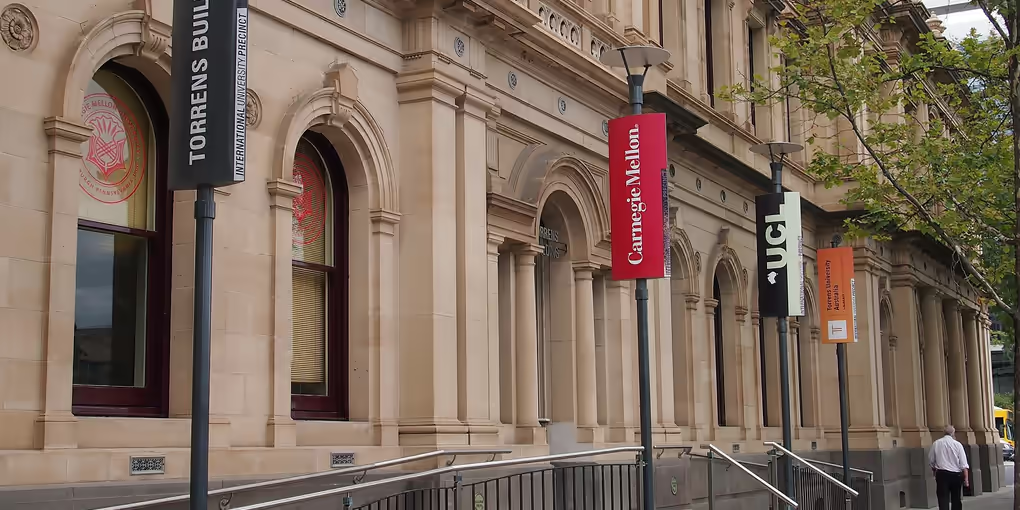
Torrens campuses tend to feel like contemporary city teaching hubs rather than sprawling sandstone quadrangles. That suits career-focused students; it disappoints applicants chasing a classic residential college aesthetic.
Why location matters for international families
- Adelaide usually means lower living costs and a calmer capital-city pace
- Sydney and Melbourne raise rent and transport costs but deepen hospitality, design and corporate networks
- Brisbane sits between those poles for many lifestyle and cost comparisons
- Switching cities mid-degree is not automatic — confirm delivery location in the offer
For GCC and Southeast Asian students, the Torrens decision is often a three-way trade: course fit, city career density, and annual living budget.
A second practical check: some programmes share branding nationally but differ in studio facilities, industry partners and class size by city. Ask for the campus-specific handbook extract — facilities list, placement partners and sample timetable — before treating Adelaide and Sydney versions of a similarly named degree as interchangeable.
Student demographic and culture
With around 19,000 students, Torrens is large enough for a diverse international community while remaining teaching-led. Culture tends to feel:
- Career-conscious and applied rather than research-prestige-driven
- International and cosmopolitan on the larger city campuses
- More timetable-flexible than highly traditional lecture-heavy universities
- Less “one student village” identity, because campuses are distributed across cities
Male to female balance
Varies by school:
- Hospitality, tourism and design cohorts are often mixed, with design sometimes leaning female in particular studios
- Business and project management typically sit closer to balanced
- Technology intakes may lean male, though this varies by major
- Health programmes often enrol more women
Who tends to thrive at Torrens
Students who usually succeed are those who:
- Want applied learning with clear links to jobs in business, hospitality, design, health or technology
- Prefer a private, industry-facing university culture over research rankings
- Can choose a city deliberately and stick to the campus that offers their course
- Are motivated by projects, studios and industry briefs rather than pure theory
- Need a somewhat more accessible English entry point for undergraduate study
Students chasing Group of Eight research prestige or a single classic residential campus often shortlist elsewhere.
Accommodation options
Torrens does not always centre on large owned residential halls the way some traditional universities do. Typical arrangements include:
- Purpose-built student accommodation near city campuses
- Homestay options in some cities for first-arrival support
- Private share houses once students know their neighbourhood and timetable
Because campuses are city-based, housing markets follow local CBD and inner-suburb prices.
Hospitality students on late kitchen or service shifts should prioritise housing with safe night transport links; design students often want slightly more desk space at home for portfolio work. Those two practical preferences sound minor until a generic shared room makes either timetable miserable.
Cost and budgeting notes for international families
- Adelaide budgets stretch further than Sydney or Melbourne for the same lifestyle
- Hospitality and design students should allow for uniform, toolkit or software costs beyond tuition
- OSHC is required for the subclass 500 visa
- Factor airport transfers and bond deposits for private rentals
- Confirm whether any industry placement weeks require travel away from the home campus city
For tuition figures, deposits and scholarships, see Fee structure below.
Fee structure
For GCC and Southeast Asian families, Torrens typically sits around A$25,000–A$38,000 per year for undergraduate international study, with postgraduate taught programmes often around A$27,000–A$42,000. Private-provider pricing varies considerably by programme and campus — always confirm the latest AUD figures on the official course page and offer letter.
International tuition fees (indicative, 2026/27, in AUD)
| Level | Typical annual tuition |
|---|---|
| Undergraduate — Business, Project Management | Commonly around A$25,000–A$32,000 per year |
| Undergraduate — Hospitality, Tourism, Technology | Commonly around A$26,000–A$34,000 per year |
| Undergraduate — Design and selected Health programmes | Commonly around A$28,000–A$38,000 per year |
| Postgraduate taught | Often around A$27,000–A$42,000 per year (varies widely) |
Useful points for parents:
- Scholarships and promotions can change effective cost significantly between intakes.
- Design and health courses may add materials, software, uniform or placement costs.
- Always match the fee schedule to the confirmed campus, not a generic Torrens average.
Deposit, CoE and payment timing
After accepting an eligible offer, students receive a Confirmation of Enrolment (CoE) to support the Student visa (subclass 500) application. Torrens typically requires a deposit or initial tuition payment before CoE issuance.
Families should plan for:
- Campus-specific offer received
- Deposit paid by the deadline in the offer letter
- CoE issued
- Subclass 500 visa lodged with the CoE and financial evidence
- Remaining tuition paid by trimester/semester according to Torrens payment options
Scholarships and fee reductions (high-level)
Torrens Global Education pathways often include:
- International merit scholarships tied to academic results
- Programme or intake promotions that reduce first-year or ongoing fees
- Progression incentives for students moving from pathway partners into Torrens degrees
Practical tip: ask for the scholarship expiry date in writing — private-provider offers can be time-limited.
Living costs beyond tuition
Budget separately for:
- City-specific rent (Adelaide vs Sydney/Melbourne/Brisbane)
- Food, transport and personal expenses
- OSHC
- Course materials and placement costs
- Flights and arrival setup
If comparing Adelaide against Sydney for the same course family, build a two-column annual cost sheet (tuition + rent + transport + OSHC) rather than deciding on city prestige alone.
Admission procedure
Undergraduate applications
Most international undergraduates apply directly to Torrens University Australia or through an approved education agent — not via UCAS.
Typical requirements include:
- Secondary schooling equivalent to Australian Year 12, assessed by country
- Meeting course prerequisites (portfolios for some design awards; subject backgrounds for some health/tech routes)
- Transcripts, passport details and application form
- English evidence — commonly around IELTS 6.0 overall (no band below 5.5) for many undergraduate courses; check exceptions
Postgraduate applications
Postgraduate taught entry usually requires:
- A recognised bachelor’s degree in a relevant field (or approved professional experience pathways where offered)
- Transcripts, CV and sometimes a statement of purpose
- English evidence — commonly around IELTS 6.5 overall (no band below 6.0)
- Portfolios or interviews for selected design and creative awards
Step-by-step pathway for international families
- Lock the course and the campus together — availability is not national by default.
- Check accreditation for any regulated health or professional field.
- Apply directly or via an approved agent with certified documents and portfolio if needed.
- Receive and compare offers, including scholarship conditions.
- Accept, pay the deposit and obtain the CoE.
- Apply for the subclass 500 student visa.
- Arrange city housing and any placement readiness requirements.
Intakes and timing
- Torrens commonly offers multiple intakes across the year (often including February, June and September-style starts depending on the programme) — confirm the exact calendar for your course.
- Popular hospitality and business intakes can fill in preferred cities first — apply early if Sydney or Melbourne is essential.
Documents checklist (typical)
- Academic transcripts and certificates
- Passport copy
- English test results
- Portfolio (design and some creative courses)
- CV (especially postgraduate)
- Proof of funds for visa purposes
For GCC and SEA applicants: where direct entry grades fall short, Torrens pathway options through related providers may be available — confirm which pathway articulates into the exact degree and campus you want.
Pathway students should get the articulation map in writing: which credits transfer, which campus the bachelor stage runs on, and whether scholarship conditions reset at the degree stage. Vague agent assurances are not enough when living costs and visa length depend on the full pathway duration.
Academic intensity and social life
Teaching at Torrens leans applied: industry projects, studio critiques, hospitality operations assessments, business case work and technology practicals. Students who prefer purely theoretical study sometimes find the pace more vocational than academic-prestigious — which is intentional.
What students can generally expect:
- Smaller teaching groups than Australia’s largest public lecture theatres in many subjects
- Assessment tied to workplace-style deliverables
- City-campus social life that spills into the surrounding urban area
- Less of a single “campus bubble” than residential universities
Social life in practice
Friendships often form inside studios, hospitality labs and project teams. International students in Adelaide frequently describe easier settling costs; those in Sydney or Melbourne trade higher expenses for denser industry networking and a busier city social calendar.
Because teaching sites sit inside commercial city fabrics, social life often looks like after-class coffee near campus, industry guest nights and weekend city exploration rather than a single enclosed residential bubble. Students who enjoy that urban rhythm settle quickly; those who wanted a gated campus village should shortlist differently.
Sports, societies and wider profile
Extracurricular life varies by city campus:
- Student clubs and events oriented around business, hospitality and creative communities
- Access to city gyms and community sport rather than one dominant on-campus stadium culture
- Industry showcases, pop-ups and graduate exhibitions for design and hospitality students
- International student support services on major campuses
For GCC and SEA students, joining course-based project teams and industry events usually builds networks faster than waiting for a traditional residential college scene.
Hospitality and design showcases are particularly worth treating as career events, not optional social extras — employers and alumni often attend, and first impressions can matter as much as a polished CV.
Careers and employer reputation
Torrens’ employer story is strongest where applied skills and industry projects are visible on a CV.
Where Torrens can be especially sensible
- Students targeting hospitality, tourism, applied business, design, project management or practical technology roles
- Families wanting multi-city flexibility and a private-university teaching style
- Applicants who benefit from more accessible undergraduate English requirements
- Students who prefer career framing earlier than a long generalist undergraduate model
Where families should be realistic
- Research prestige is not Torrens’ primary currency — do not shortlist it as a Go8 substitute
- Course-campus mismatch is a common planning error
- Regulated professions need careful accreditation checks before deposit payment
Used well, Torrens is an industry-oriented private multi-campus choice — strongest when the family has already chosen the career field and wants flexible Australian city delivery. It is a weak substitute for families whose real goal is a research-intensive Group of Eight brand with laboratory depth; it is a strong fit when the goal is applied skills, multiple intakes and a clear line from classroom projects to industry conversations.
Who should shortlist Torrens University Australia?
Consider shortlisting Torrens if your child:
- Is drawn to business, hospitality, tourism, design, health, technology or project management
- Wants an applied, industry-facing private university rather than research rankings
- Needs to compare Adelaide versus east-coast campuses for cost and opportunity
- Benefits from undergraduate English requirements around IELTS 6.0 on many courses
- Prefers flexible intakes and career-oriented assessment
Consider other options first if your child:
- Is chasing Group of Eight research prestige or highly selective medicine
- Wants a classic single residential campus experience
- Has not confirmed that the intended course actually runs in the preferred city
How Tutopiya helps
Tutopiya works with students aiming for Torrens University Australia and other Australian universities by:
- Strengthening grades and portfolios relevant to business, design, hospitality and technology pathways
- Helping families map course-to-campus fit before applications are lodged
- Preparing for English targets and direct applications (including portfolio guidance where relevant)
- Clarifying AUD fees, scholarships, deposits and CoE timing for the subclass 500 visa
- Providing counselling that weighs private applied universities against public research alternatives honestly
- Issuing reference letters for tutoring and homeschooling students where Tutopiya has supported the academic programme
- Connecting families with unpaid internship and work-experience opportunities (where available) to strengthen applications and early employability
If you’d like tailored advice for your child’s situation, you can talk to Tutopiya’s team about a joined-up plan covering both exam preparation and university admissions.
🎓 Free tool
Build your personalised shortlist for Torrens University Australia →
See entry requirements matched to your own grades, tuition, deadlines and reach/target/safety tiering — free, no signup needed to browse.
Ready to Excel in Your Studies?
Get personalised help from Tutopiya's expert tutors. Whether it's IGCSE, IB, A-Levels, or any other curriculum — we match you with the perfect tutor and your first session is free.
Book Your Free TrialWritten by
Tutopiya Team
Related Articles

Heriot-Watt University Dubai – University Guide for GCC and Southeast Asian Students
Detailed guidance for international students from the Gulf and Southeast Asia considering Heriot-Watt University Dubai, including fees, admissions, campus life, accommodation and graduate outcomes.

University of Birmingham Dubai – University Guide for GCC and Southeast Asian Students
Detailed guidance for international students from the Gulf and Southeast Asia considering University of Birmingham Dubai, including fees, admissions, campus life, accommodation and graduate outcomes.

Abu Dhabi University – University Guide for GCC and Southeast Asian Students
Detailed guidance for international students from the Gulf and Southeast Asia considering Abu Dhabi University (ADU), including fees, admissions, campus life, accommodation and graduate outcomes.